Auteur/autrice : julien

  • RÉGÉNÉRER LA NATURE,C’EST RÉGÉNÉRER L’ÉCONOMIE

    RÉGÉNÉRER LA NATURE,C’EST RÉGÉNÉRER L’ÉCONOMIE

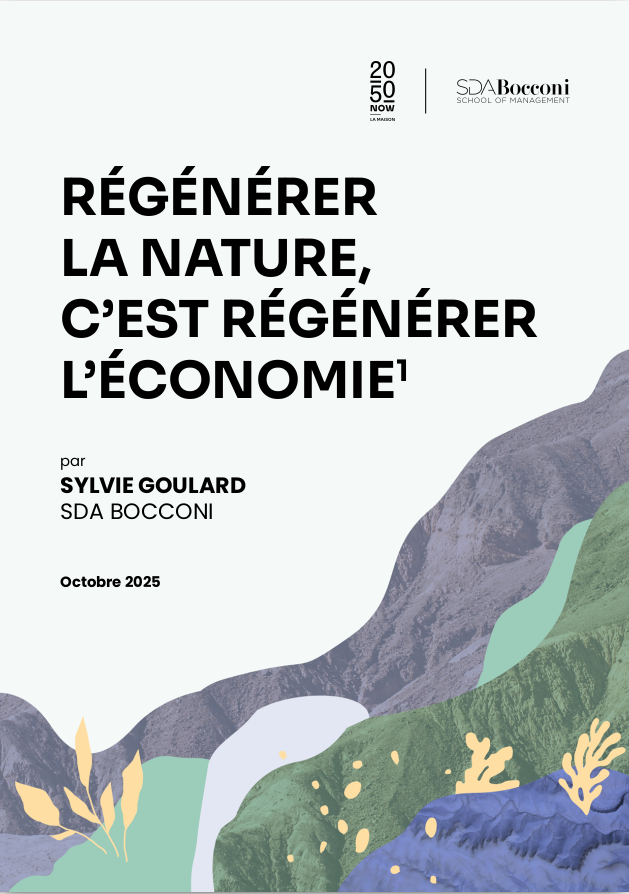
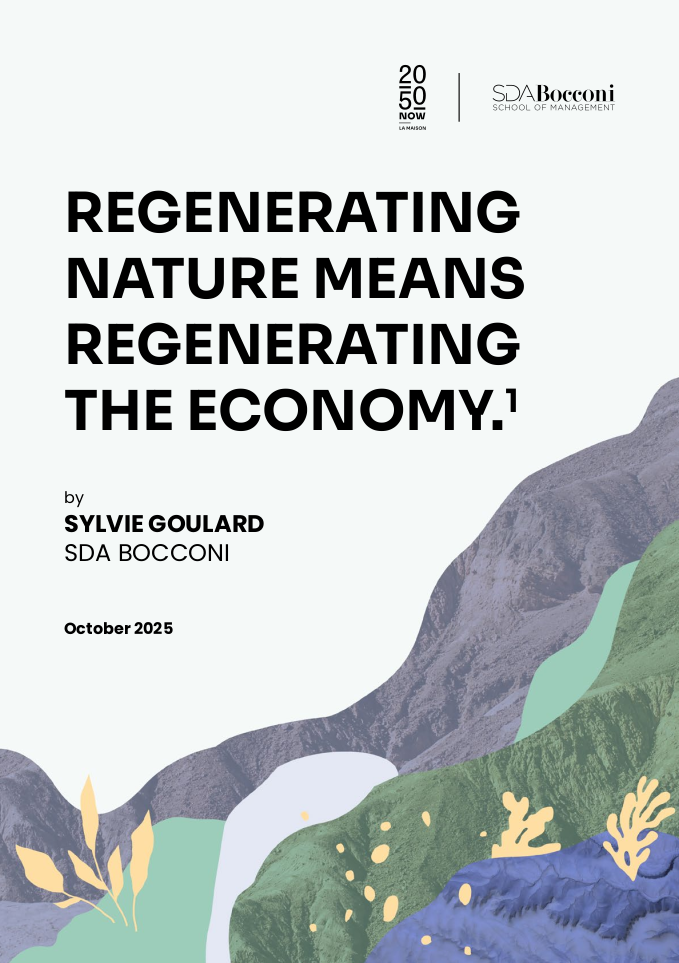
    En octobre 2025, a été publié ce rapport intitulé Régénérer la Nature, C’est Régénérer l’Économie, en partenariat avec la plateforme 2050Now et l’équipe du Sustainability Lab de Bocconi. Ce document fait suite à une étude précédente, Détruire la nature, c’est détruire l’économie (janvier 2025), et vise à promouvoir une approche positive et actionnable pour intégrer la préservation de la nature au cœur des stratégies économiques.

    Ce rapport de 72 pages explore comment les entreprises peuvent se transformer grâce aux solutions fondées sur la nature, en reliant étroitement les enjeux climatiques et la biodiversité. Il s’appuie sur des exemples concrets d’entreprises partenaires (comme BCG, BETC, BNPP, Bouygues, ENGIE, LVMH, SNCF Voyageurs et Veolia), des recherches scientifiques, et des analyses sur les sols, l’eau, les océans, la résilience, et la coopération avec les parties prenantes. Les messages clés soulignent l’urgence d’agir pour préserver les chaînes de valeur, mesurer les impacts, et favoriser une économie régénérative, inclusive et durable.

    Voici un aperçu de la structure principale :

    • Messages clés (p. 4) : Cinq points essentiels sur l’urgence écologique, les solutions nature-based, la résilience intégrée, la mesure des impacts, et l’inclusion des acteurs.
    • Introduction : « Business in Nature » (p. 5-8) : Un contexte mondial sur les défis géopolitiques, climatiques et environnementaux, avec des références à des travaux de recherche comme ceux de Stefano Pogutz et Monika Winn.
    • Partie 1 : Se transformer grâce aux solutions fondées sur la nature (p. 9 et suivantes) : Focus sur les sols, l’eau et les océans pour une agriculture et une gestion régénératrices.
    • Partie 2 : Mettre la nature au cœur de la résilience (p. 32) : Mesure, sécurité, compétitivité et préservation.
    • Partie 3 : Inclure et coopérer (p. 52) : Connaissance, persuasion et action durable.
    • Conclusion : Une vision à long terme où régénérer la nature fonde une prospérité humaine durable.

    Ce rapport invite les entreprises, décideurs et citoyens à agir sans délai, en s’appuyant sur la science et des pratiques concrètes. Pour plus de détails, je vous encourage à explorer les sources citées et les exemples d’initiatives.
  • REGENERATING NATURE MEANS REGENERATING THE ECONOMY

    REGENERATING NATURE MEANS REGENERATING THE ECONOMY

    In October 2025, was published this report titled Regenerating Nature is Regenerating the Economy, in partnership with the 2050Now platform and the Sustainability Lab team at Bocconi. This document follows my previous study, Destroying Nature is Destroying the Economy (January 2025), and aims to promote a positive and actionable approach to integrating nature preservation at the heart of economic strategies.

    This 72-page report explores how companies can transform themselves through nature-based solutions, closely linking climate challenges and biodiversity. It draws on concrete examples from partner companies (such as BCG, BETC, BNPP, Bouygues, ENGIE, LVMH, SNCF Voyageurs, and Veolia), scientific research, and analyses on soils, water, oceans, resilience, and cooperation with stakeholders. The key messages emphasize the urgency of action to preserve value chains, measure impacts, and foster a regenerative, inclusive, and sustainable economy.

    Here is an overview of the main structure:

    • Key Messages (p. 4): Five essential points on ecological urgency, nature-based solutions, integrated resilience, impact measurement, and actor inclusion.
    • Introduction: “Business in Nature” (p. 5-8): A global context on geopolitical, climate, and environmental challenges, with references to research works like those by Stefano Pogutz and Monika Winn.
    • Part 1: Transforming Through Nature-Based Solutions (p. 9 and following): Focus on soils, water, and oceans for regenerative agriculture and management.
    • Part 2: Placing Nature at the Heart of Resilience (p. 32): Measurement, security, competitiveness, and preservation.
    • Part 3: Including and Cooperating (p. 52): Knowledge, persuasion, and sustainable action.
    • Conclusion: A long-term vision where regenerating nature forms the basis of sustainable human prosperity.

    This report invites companies, decision-makers, and citizens to act without delay, relying on science and concrete practices.

  • Nuclear power and jellyfish

    Nuclear power and jellyfish

    In this article « Nuclear Power and Jellyfish » (SDA Bocconi Insight, La Libellula, September 2025), I use the August 2025 jellyfish invasion that shut down units at France’s Gravelines nuclear plant as a stark reminder of climate change’s real and interconnected impacts.

    While nuclear power is promoted for its low-CO2 benefits, energy sovereignty, and competitiveness, it remains vulnerable to warming seas (fostering jellyfish blooms) and rivers (preventing cooling water discharge), leading to costly shutdowns.

    I argue against prioritizing short-term competitiveness over ecology, highlighting invasive species as a major environmental pressure (per IPBES), alongside threats to tourism, health, and prosperity from droughts, heatwaves, and species proliferation.

    I call for collaborative public-private efforts in mitigation, adaptation (e.g., upgrading plants), and conservation, urging us to heed nature’s warnings rather than ignore science.

  • « La loi Duplomb révèle une triple dérive sur l’économie, la science et l’Europe »

    « La loi Duplomb révèle une triple dérive sur l’économie, la science et l’Europe »

    Dans cette tribune, est critiquée la loi Duplomb (visant à exploiter les minerais des fonds marins) comme révélatrice d’une triple dérive :

    • Économique : Illusion de relance par des ressources non renouvelables, au détriment d’une vraie innovation.
    • Scientifique : Mépris des alertes des experts sur les risques irréversibles pour les écosystèmes marins.
    • Européenne : Affaiblissement de la position de l’UE, pionnière en protection environnementale, face à la concurrence internationale.

    J’appelle à privilégier une approche durable et cohérente avec les engagements climatiques et biodiversité de l’Europe.

  • With a sea view

    With a sea view

    In this article « With a Sea View » (SDA Bocconi Insight, La Libellula), I emphasize the ocean’s vital yet undervalued role in the biosphere—covering 70% of Earth and hosting 95% of its life—arguing that greening terrestrial economies is insufficient without addressing marine risks and opportunities.

    Reflecting on the June 2025 UN Ocean Conference in Nice and related events, I highlight progress in high-seas biodiversity protection, marine conservation, decarbonizing shipping, and reducing plastics. Key points include:

    Persistent multilateral cooperation amid challenges, offering grounds for optimism in shifting to a regenerative blue economy.te ….

    Integration of finance into ocean sustainability (e.g., investments needed for ecosystem restoration).

    Emerging tools like the Ocean Impact framework (SDA Bocconi et al.) for assessing business impacts on seas, and biodiversity credits pilots.

  • GREEN DISCLOSURE: RED TAPE OR STRATEGIC TOOL?

    GREEN DISCLOSURE: RED TAPE OR STRATEGIC TOOL?

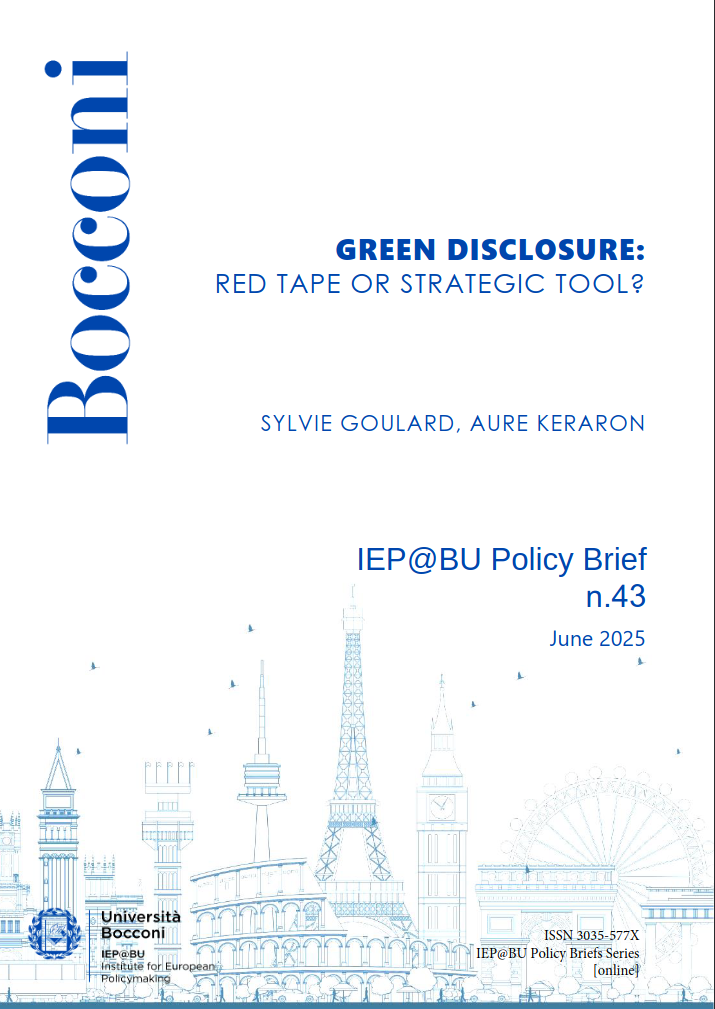
    In this IEP@BU Policy Brief No. 43 (June 2025), titled Green Disclosure: Red Tape or Strategic Tool?, we (Sylvie Goulard and Aure Keraron) argue that the EU’s Corporate Sustainability Reporting Directive (CSRD) – with its double materiality and assurance requirements – is a vital strategic tool, not mere bureaucracy.

    While the 2025 Omnibus simplification package seeks to ease burdens amid economic pressures, we caution that excessive rollbacks risk undermining the Green Deal, fragmenting the single market, eroding Europe’s green competitiveness, and ignoring ongoing climate and biodiversity crises.

    Reliable ESG reporting supports informed decisions, financial stability, innovation, and long-term resilience – essential for the sustainable transition.

  • In the Name of the French People: The European Consequences of Marine Le Pen’s Conviction

    In the Name of the French People: The European Consequences of Marine Le Pen’s Conviction

    In this article titled « In the Name of the French People: The European Consequences of Marine Le Pen’s Conviction » (published April 4, 2025), I defend the recent French court ruling convicting Marine Le Pen for misappropriating European Parliament funds.

    I argue that the judgment upholds the rule of law, protects European taxpayers, and is not a « political » decision, as Le Pen claims. Drawing on my own experience in the same investigation (from which I was cleared), I stress the impartiality of the process, the need for political integrity, and the broader implications for EU values.

    Criticizing international nationalists’ support for Le Pen, I highlight how the case safeguards the EU budget and democracy beyond mere elections. Appeals remain possible, but undermining judicial independence risks eroding public trust.

  • Project ALCIDE

    Project ALCIDE

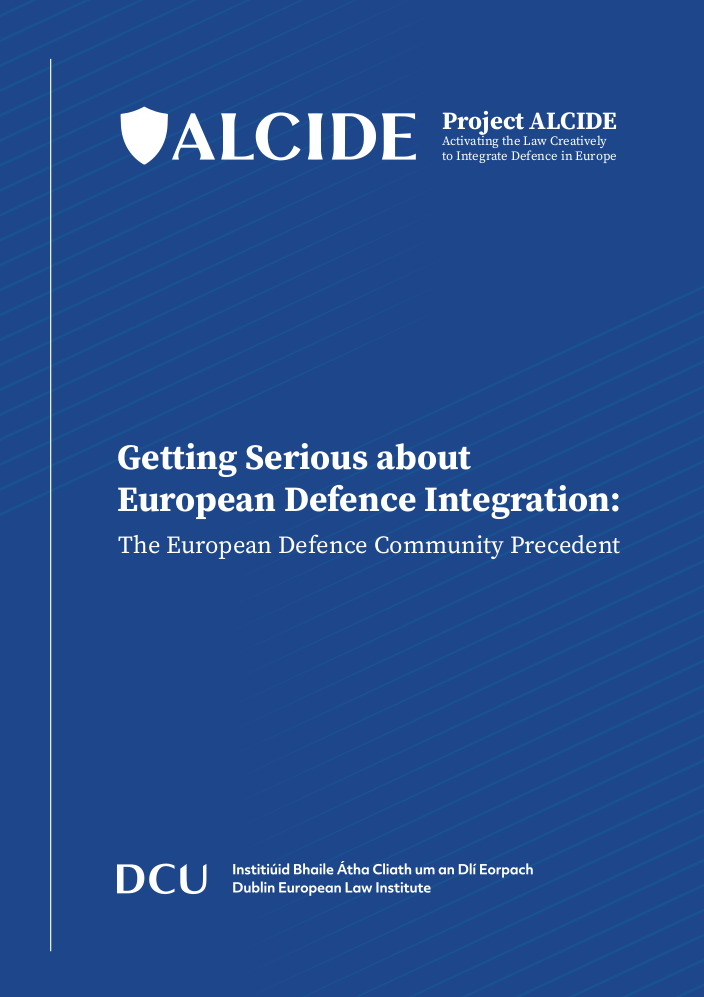
    In an era marked by escalating geopolitical tensions—Russia’s ongoing aggression in Ukraine, instability across the Middle East and North Africa, and shifting U.S. commitments under a potential second Trump presidency—Europe faces a critical imperative to fortify its defense architecture. This policy brief, authored by a distinguished ALCIDE Working Group of legal scholars, historians, economists, political scientists, and former policymakers, revives the conversation around the European Defence Community (EDC). Published in 2025 by the Dublin European Law Institute (DELI) at Dublin City University, the document draws on the EDC’s 1952 treaty as a foundational blueprint for deeper integration, emphasizing supranational structures to achieve strategic autonomy while maintaining NATO ties.

    The EDC, signed by six founding states (Belgium, France, West Germany, Italy, Luxembourg, and the Netherlands) but never fully ratified due to French parliamentary opposition, proposed a unified European army with shared forces, budget, and institutions. This report argues that reviving it—legally feasible through ratification by France and Italy—could address Europe’s current fragmentation, from inefficient procurement to veto-prone decision-making. It outlines the EDC’s core features, historical context, benefits (e.g., democratic accountability and industrial efficiency), challenges (e.g., nuclear integration and EU alignment), and alternatives, urging a bold debate beyond piecemeal reforms. As Europe spends over 2% of GDP on defense yet lacks cohesion, this precedent offers a path to credible deterrence in a multipolar world.

  • Grande da morire: Come evitare l’esplosione dell’Europa

    Grande da morire: Come evitare l’esplosione dell’Europa

    È giunto il momento di porsi domande molto più profonde su cos’è l’Unione e su ciò che dovrebbe diventare

    I leader europei hanno deciso: l’Ucraina, la Moldavia, la Georgia e tutti i paesi dei Balcani occidentali entreranno nell’Unione europea. Le buone argomentazioni non mancano ma, di fronte a Putin determinato a distruggere tutto ciò che rappresenta, l’UE non ha margine di errore, soprattutto dopo l’elezione di Donald Trump alla Casa Bianca. Tuttavia il processo è stato avviato senza un piano preciso né un accordo sugli elementi essenziali. Lungi dal rafforzare l’UE, questa decisione potrebbe ostacolarne l’azione, privandola al tempo stesso della sua efficacia. È una corsa a capofitto mentre l’Europa non ha ancora una politica estera, una difesa unificata, un bilancio degno di questo nome. Inoltre, questi leader non hanno imparato nulla dall’illusione turca vent’anni fa o dalla Brexit? In Europa nulla è mai scontato, soprattutto quando il nazionalismo ritorna prepotente. Non è più il momento di fingere che l’unione fa la forza senza prima occuparsi di creare unità.

  • Sylvie Goulard : « La fin de la guerre froide a donné aux Allemands l’illusion de la sécurité »

    Sylvie Goulard : « La fin de la guerre froide a donné aux Allemands l’illusion de la sécurité »

    Dans cet article-interview publié sur WARM, Sylvie Goulard (présidente de l’Institut franco-allemand de Ludwigsburg et membre du Conseil de la Conférence de Sécurité de Munich) analyse la situation allemande à l’approche des élections du 23 février 2025.

    Points principaux :

    • Élections et politique intérieure : Incertitude due au système électoral et à la montée de l’AfD (environ 20 % dans les sondages), parti eurosceptique et hostile à l’OTAN. Ses idées influencent le débat, même si la CDU (en tête à 30 %) refuse toute alliance.
    • Économie : L’Allemagne a réduit sa dépendance au gaz russe, mais reste vulnérable face aux coûts énergétiques, aux menaces protectionnistes (Trump) et à la concurrence chinoise, en raison de son modèle exportateur.
    • Transition écologique : Critiques contre le Green Deal européen, vu comme bouc émissaire. Goulard défend ses outils et note que reculer sur le climat masquerait des problèmes structurels plus profonds (manque d’innovation, investissements).
    • Sécurité et défense : La fin de la guerre froide a créé chez les Allemands une « illusion de sécurité » via le commerce (« Wandel durch Handel ») avec Russie et Chine. Malgré le « Zeitenwende » de Scholz post-Ukraine, des résistances pacifistes persistent, et il manque une vraie initiative européenne en matière de défense.

    Goulard voit un « momentum » historique : l’Allemagne doit adapter son modèle économique, assumer ses responsabilités sécuritaires et surmonter ses blocages internes pour affronter ces défis.