
Auteur/autrice : julien

  • How Europeans see a vote for Brexit – The Guardian 21/06/2016

    How Europeans see a vote for Brexit – The Guardian 21/06/2016

    Jennifer Rankin in Brussels, Angelique Chrisafis in Paris, Kit Gillet in Bucharest, Philip Oltermann in Berlin and Helena Smith in Athens

    Some think the vote is stupid or playing into Putin’s hands, while others regard it as a chance to give Brussels a run for its money

    If Britain votes to leave the European Union, it could be cast out of Europe in one very literal way.

    Brexit might cost the UK its place in Mini-Europe, a Brussels theme park, where European landmarks, including the Eiffel Tower, the Acropolis and Mount Vesuvius, are recreated in painstaking miniatures. If Britain votes to leave, the British models – including the Houses of Parliament, Anne Hathaway’s cottage and a 1970s vintage British Rail intercity train – could be banished from the theme park. “

    [Britain] could not stay in the park and that would be a real problem,” said Thierry Meeùs, Mini-Europe’s owner and director.

    The Brits would be missed, not only because Meeùs has just spent €120,000 (£95,000) renovating Big Ben and its clock tower, finished with gold leaf. “It would be a real hole in the European history that I would like to show here,” he added.

    In Mini-Europe there is no half-in/half-out: no place for European Free Trade Association members Norway or Switzerland, or for EU hopefuls Albania and Kosovo. Meeùs says he turned down a request from Turkey because it is not a member state.

    Meeùs hopes the UK will stay because it makes “a positive contribution” to the EU: “British people oblige many European countries to ask the right questions – why are we doing this?”

    Some visitors to the park were less diplomatic. The referendum “is stupid”, said Gregor, a 31-year-old project manager from Antwerp. “I think [Brexit] would be a bad thing because it gives a signal to other countries that [the EU] cannot handle a difficult period.”

    The British debate about the EU provokes perplexity. “I don’t understand why they are doing it,” said Ben Kabba, an 18-year-old Danish student visiting Brussels on a school trip. “We are kind of a family and we should stick together and support each other. We might not have as much power as America and Russia.”

    These themes – a mix of bewilderment and geopolitical anxiety – resonate among government officials. One Belgian official, a keen observer of the British political scene, said it was hard to understand how it had reached the point where the UK might leave. The only winner would be Russia’s president: “If there were a Brexit it would play into the hands of [Vladimir] Putin.”

    View from Paris

    Despite the love-hate metaphors ever since General de Gaulle vetoed Britain’s entry to the common market in the 1960s, a majority of French people have a positive view of the UK and want Britain to stay in the EU.

    Viewed from Paris, the referendum is a reminder of France’s own painful and divisive poll in 2005 when the country voted no to the EU constitution.

    Members of France’s Socialist government – as well as the mainstream rightwing opposition – keenly want Britain to remain but ministers are tight-lipped, saying in private they don’t want to be seen to interfere from abroad, fearing it would be counterproductive. France knows that whatever the outcome of the referendum on 23 June, questions will weigh heavily in Paris about the very nature of the European project.

    Sylvie Goulard, a French centrist MEP who has just published a book, Goodbye Europe, on the lessons to be learned from David Cameron’s recent “new deal” in Brussels, is in favour of Britain staying in the EU and has observed two phenomena in the campaign. “First, I’ve noticed that the government and Mr Cameron seem to have discovered Europe in the positive sense and so they are becoming more convincing. Mr Cameron seems more convinced about Europe than he was, even if I don’t agree 100% with his vision. At least there are people trying to sell Europe in the UK, which isn’t something easy,” she said.

    “Second, I’ve noticed that the debate is often based on exaggeration. You can dislike the European Union, but it’s not comparable to Hitler invading the UK. We should respect the people who died in the second world war. The same is true of Michael Gove saying millions of Muslims would come to the UK tomorrow if Turkey joined the EU. I admire the way British democracy functions and there are many elements to be proud of, but sometimes exaggeration seems to be the normal way of arguing – and where Europe is concerned, even more so.”

    Yannick Dupuis, 54, an equipment manager for French railways, from near Lille, said: “Britain has always been an island and it has clearly always wanted its sovereignty in one way or another.” He voted no in France’s 2005 referendum. But, with economic turmoil in an increasingly globalised world, he wasn’t sure if Britain would be more exposed if it left. “Given the global situation right now, I really don’t know if it’s good for the British to stay or leave. What’s at stake still seems to be obscure for most people.”

    Alain Poupaux, from the Paris suburbs, who has retired after a career in international insurance, feels there is a growing sense that Europe had done more for the world of finance than for the people. “If Brexit happens, it will be taken as a kind of warning to reform the European Union so it better reflects people’s interests. But I wonder if people will ultimately feel afraid to vote to leave Europe because they don’t know how it will go afterwards. In any case, the UK already has one foot outside Europe: you kept the pound, you’re not in Schengen. You’re already one step removed.”

    View from Berlin

    Attitudes have broadly shifted in recent months, from mild annoyance with the British “cherry-picking” a personalised menu from the EU treaties, to genuine shock that the UK could choose to leave the EU.

    “What I don’t understand is: why are you Brits feeling so bold?” asked political activist Oliver Moldenhauer during a Brexit workshop for British migrants living in Berlin. “Why are people who are so scared of losing their status at the same time so willing to take such a huge risk? It seems you only have things to lose from this referendum.”

    What depressed him about the EU debate in Britain, Moldenhauer said, was that it was concentrated purely on British interests. “Hardly anyone seems to be making the point that Britain should stay because it would help Europe as a whole.”

    Off the record, many parliamentarians advocate a hardline stance in any post-Brexit negotiations. During a recent trip to Westminster, one senior Social Democrat handed British MPs a Brexit-themed short story set in 2030 that implied the UK would have to sign up to the euro if it ever asked to rejoin the EU.

    “It’s an illusion that things would continue as they were before,” said Katarina Barley, the general secretary of the Social Democratic party, who holds dual British-German citizenship. “Negotiations would start at zero. We can’t have a scenario where one country gets all the advantages out of the EU but doesn’t shoulder any responsibilities. You can’t have free movement of goods while opting out of free movement of peoples.”

    What makes the tone of debate in Germany different from that in France is that none of the significant political figures are actively cheering on a British exit.

    Unlike in France, even Germany’s Eurosceptic right does not support Brexit. Alexander Gauland, the deputy chairman of Alternative für Deutschland, who is considered the chief thinker behind the anti-immigration party, said: “When it comes to Brexit, there are two hearts beating in our chest. There is one view that Britain leaving the EU is a good thing, because it will destroy the idea of an ever-closer union.

    “The other view, which is closer to my own, is that as long as Britain remains inside the European Union they help to block certain other ideas of what kind of union it should be, and that Britain helps to shape the EU in the way we imagine it: a Europe of cooperating fatherlands, but not a United States of Europe with federal elements in the way the French love to imagine it. That is why I would plead for Britain to remain in the European Union.”

    Gauland, an anglophile who has written books on the House of Windsor, used to drive a classic Mini and whose office at the Brandenburg state parliament is adorned with 18th-century portraits of British parliamentarians, said he would support a lenient course in post-Brexit negotiations with Britain.

    Yet he dismissed the argument, put forward by Brexit advocates such as Michael Gove, that a British vote to leave could trigger a wave of similar secession movements across the continent, including in Germany.

    “If we were to leave Nato or the EU, which some people in our party want, then that would trigger a debate: is Germany still predictable? Is it too strong for its neighbours? Diplomatically, you have to respect those concerns. It would not be wise for Germany to leave the EU, because we could quickly slip into ill-advised isolation.”

    View from Athens

    When asked to ponder the prospect of Brexit, the fate of European currencies was the first thing that came to Pavlos Kannelopoulos’s mind. “Italy was better off when it had the lira, France was better off with the franc, Spain was better off with the peseta, Germany was better off with the deutsche mark,” says the jeweller tapping his forefinger to make the point on the doorstep of his downtown store. “And us! We were much better off when we had the drachma. The English, they’re clever. They kept their currency, so why stay in this so-called union at all?”

    Britain’s referendum has received relatively little publicity in Greece, which is preoccupied with its own euro woes. In private, Athens’ pro-European political elite insist the 28-member bloc would not be the same without the UK. Some politicians go so far as to admit that if, on the eve of the ballot, polls indicated victory for the leave camp, they hoped the Queen would intervene. But on the street there is sympathy for Brexiters. And, as anti-European sentiment grows, the popular view among Greeks appears to be that Britons should give Brussels a run for its money.

    “They’ll do very well if they vote leave,” said Kleanthis Papazoglou, an unemployed factory worker. “Every day Europe is becoming a little bit more fascistic. The euro has failed. Much better, each to their own.”

    Relief that Athens may have been cut some slack in its own debt negotiations with Brussels as a result of the UK’s referendum is also evident.

    “There’s a feeling we got a good deal because everyone wanted to avoid a new Greek crisis,” said Dimitris Keridis, professor of political science at Panteion University in Athens.

    But that is not the sentiment among Greek MEPs and business leaders. Both fear Brexit and the potentially explosive effect it could have for Greece’s battle to remain in the single currency and, by extension, the EU.

    “It would be a catastrophic move,” said Andreas Andreas, the country’s tourism chief. “Great Britain counters the influence of Germany in the EU. It is a balancing force. If it leaves, it will definitely lead to further integration of a much smaller number of countries around Germany, which will mean the rest will become totally peripheral and even irrelevant to the European dream.”

    In Brussels, Georgios Kyrtsos, who sits on a working group set up by the centre-right European People’s party (EPP) to analyse poll dynamics and data before the vote, said MEPs were far from sure which camp would prevail. “What I do know, and fear, is that in the event of leave winning there will be a move to integrate further and Greece will never be able to keep up,” he said by phone from the Belgian capital. “The Germans and the French will take steps to make up for the loss of the UK and will impose criteria that’ll be so tough Greece won’t be able to follow. It can, after all, barely keep apace now.”

    View from Bucharest

    For a nation that fought hard to get into the EU, Romania sees a certain comic timing in the UK’s Brexit referendum and potential exit from the union.

    “We in this region have struggled to get out of communism, and join the European club. But once inside everything crumbles, with Greece and now the Brexit,” said Adrian Moraru, deputy director of the Institute for Public Policy in Bucharest.

    In February, just before the Brussels summit to try to renegotiate aspects of the EU rules, Romania’s president, Klaus Iohannis, suggested a willingness to compromise in order to keep Britain in, but added that he wouldn’t accept any changes that would discriminate against Romanians. “We do not accept in any way the freedom of movement to be questioned. Likewise … we cannot accept that someone who comes from Romania is treated differently than someone from Spain or Italy,” he told local media at the time.

    Alina Mungiu-Pippidi, a Romanian political scientist, sees a certain hypocrisy at play, noting the way that Britain pushed for enlargement to create a broader EU.

    “The vision of a broader EU was Britain’s vision, so it is bizarre that after the others did what you wanted you talk about leaving the boat, saying it is no longer for you,” she said. But “the main people concerned about the Brexit are those Romanians who work in the UK, or plan to work in the UK, but they don’t seem worried”, she added. “If people felt after a Brexit that Romanian workers would no longer be able to go to the UK there would be sheer panic here.”

    On the streets of Bucharest, some said they understood the concerns of those in Britain wanting to leave.

    “You have to think as a middle-class Brit, and I think it is normal for Brits to want out,” said Mihai Cismaru, a 37-year-old EU funds consultant. “The middle class in Britain doesn’t feel the plus value. As a Romanian, before entering the EU we had to have visas to travel to many places in Europe, now we don’t, but as a Brit it was still very simple before the EU. When you see Britain, France, Germany supporting the EU budget you can understand,” he added.

    “I would be sad if the UK left the EU, but maybe it would mean some Romanians coming home. I think it would weaken the EU, though,” said Ioana Loliceru, a bank worker.
  • How Europeans see a vote for Brexit – The Guardian 21/06/2016

    How Europeans see a vote for Brexit – The Guardian 21/06/2016

    Jennifer Rankin in Brussels, Angelique Chrisafis in Paris, Kit Gillet in Bucharest, Philip Oltermann in Berlin and Helena Smith in Athens

    The Guardian – Tuesday 21 June 2016

    Some think the vote is stupid or playing into Putin’s hands, while others regard it as a chance to give Brussels a run for its money

    If Britain votes to leave the European Union, it could be cast out of Europe in one very literal way.

    Brexit might cost the UK its place in Mini-Europe, a Brussels theme park, where European landmarks, including the Eiffel Tower, the Acropolis and Mount Vesuvius, are recreated in painstaking miniatures. If Britain votes to leave, the British models – including the Houses of Parliament, Anne Hathaway’s cottage and a 1970s vintage British Rail intercity train – could be banished from the theme park. “

    [Britain] could not stay in the park and that would be a real problem,” said Thierry Meeùs, Mini-Europe’s owner and director.

    The Brits would be missed, not only because Meeùs has just spent €120,000 (£95,000) renovating Big Ben and its clock tower, finished with gold leaf. “It would be a real hole in the European history that I would like to show here,” he added.

    In Mini-Europe there is no half-in/half-out: no place for European Free Trade Association members Norway or Switzerland, or for EU hopefuls Albania and Kosovo. Meeùs says he turned down a request from Turkey because it is not a member state.

    Meeùs hopes the UK will stay because it makes “a positive contribution” to the EU: “British people oblige many European countries to ask the right questions – why are we doing this?”

    Some visitors to the park were less diplomatic. The referendum “is stupid”, said Gregor, a 31-year-old project manager from Antwerp. “I think [Brexit] would be a bad thing because it gives a signal to other countries that [the EU] cannot handle a difficult period.”

    The British debate about the EU provokes perplexity. “I don’t understand why they are doing it,” said Ben Kabba, an 18-year-old Danish student visiting Brussels on a school trip. “We are kind of a family and we should stick together and support each other. We might not have as much power as America and Russia.”

    These themes – a mix of bewilderment and geopolitical anxiety – resonate among government officials. One Belgian official, a keen observer of the British political scene, said it was hard to understand how it had reached the point where the UK might leave. The only winner would be Russia’s president: “If there were a Brexit it would play into the hands of [Vladimir] Putin.”

    View from Paris

    Despite the love-hate metaphors ever since General de Gaulle vetoed Britain’s entry to the common market in the 1960s, a majority of French people have a positive view of the UK and want Britain to stay in the EU.

    Viewed from Paris, the referendum is a reminder of France’s own painful and divisive poll in 2005 when the country voted no to the EU constitution.

    Members of France’s Socialist government – as well as the mainstream rightwing opposition – keenly want Britain to remain but ministers are tight-lipped, saying in private they don’t want to be seen to interfere from abroad, fearing it would be counterproductive. France knows that whatever the outcome of the referendum on 23 June, questions will weigh heavily in Paris about the very nature of the European project.

    Sylvie Goulard, a French centrist MEP who has just published a book, Goodbye Europe, on the lessons to be learned from David Cameron’s recent “new deal” in Brussels, is in favour of Britain staying in the EU and has observed two phenomena in the campaign. “First, I’ve noticed that the government and Mr Cameron seem to have discovered Europe in the positive sense and so they are becoming more convincing. Mr Cameron seems more convinced about Europe than he was, even if I don’t agree 100% with his vision. At least there are people trying to sell Europe in the UK, which isn’t something easy,” she said.

    “Second, I’ve noticed that the debate is often based on exaggeration. You can dislike the European Union, but it’s not comparable to Hitler invading the UK. We should respect the people who died in the second world war. The same is true of Michael Gove saying millions of Muslims would come to the UK tomorrow if Turkey joined the EU. I admire the way British democracy functions and there are many elements to be proud of, but sometimes exaggeration seems to be the normal way of arguing – and where Europe is concerned, even more so.”

    Yannick Dupuis, 54, an equipment manager for French railways, from near Lille, said: “Britain has always been an island and it has clearly always wanted its sovereignty in one way or another.” He voted no in France’s 2005 referendum. But, with economic turmoil in an increasingly globalised world, he wasn’t sure if Britain would be more exposed if it left. “Given the global situation right now, I really don’t know if it’s good for the British to stay or leave. What’s at stake still seems to be obscure for most people.”

    Alain Poupaux, from the Paris suburbs, who has retired after a career in international insurance, feels there is a growing sense that Europe had done more for the world of finance than for the people. “If Brexit happens, it will be taken as a kind of warning to reform the European Union so it better reflects people’s interests. But I wonder if people will ultimately feel afraid to vote to leave Europe because they don’t know how it will go afterwards. In any case, the UK already has one foot outside Europe: you kept the pound, you’re not in Schengen. You’re already one step removed.”

    View from Berlin

    Attitudes have broadly shifted in recent months, from mild annoyance with the British “cherry-picking” a personalised menu from the EU treaties, to genuine shock that the UK could choose to leave the EU.

    “What I don’t understand is: why are you Brits feeling so bold?” asked political activist Oliver Moldenhauer during a Brexit workshop for British migrants living in Berlin. “Why are people who are so scared of losing their status at the same time so willing to take such a huge risk? It seems you only have things to lose from this referendum.”

    What depressed him about the EU debate in Britain, Moldenhauer said, was that it was concentrated purely on British interests. “Hardly anyone seems to be making the point that Britain should stay because it would help Europe as a whole.”

    Off the record, many parliamentarians advocate a hardline stance in any post-Brexit negotiations. During a recent trip to Westminster, one senior Social Democrat handed British MPs a Brexit-themed short story set in 2030 that implied the UK would have to sign up to the euro if it ever asked to rejoin the EU.

    “It’s an illusion that things would continue as they were before,” said Katarina Barley, the general secretary of the Social Democratic party, who holds dual British-German citizenship. “Negotiations would start at zero. We can’t have a scenario where one country gets all the advantages out of the EU but doesn’t shoulder any responsibilities. You can’t have free movement of goods while opting out of free movement of peoples.”

    What makes the tone of debate in Germany different from that in France is that none of the significant political figures are actively cheering on a British exit.

    Unlike in France, even Germany’s Eurosceptic right does not support Brexit. Alexander Gauland, the deputy chairman of Alternative für Deutschland, who is considered the chief thinker behind the anti-immigration party, said: “When it comes to Brexit, there are two hearts beating in our chest. There is one view that Britain leaving the EU is a good thing, because it will destroy the idea of an ever-closer union.

    “The other view, which is closer to my own, is that as long as Britain remains inside the European Union they help to block certain other ideas of what kind of union it should be, and that Britain helps to shape the EU in the way we imagine it: a Europe of cooperating fatherlands, but not a United States of Europe with federal elements in the way the French love to imagine it. That is why I would plead for Britain to remain in the European Union.”

    Gauland, an anglophile who has written books on the House of Windsor, used to drive a classic Mini and whose office at the Brandenburg state parliament is adorned with 18th-century portraits of British parliamentarians, said he would support a lenient course in post-Brexit negotiations with Britain.

    Yet he dismissed the argument, put forward by Brexit advocates such as Michael Gove, that a British vote to leave could trigger a wave of similar secession movements across the continent, including in Germany.

    “If we were to leave Nato or the EU, which some people in our party want, then that would trigger a debate: is Germany still predictable? Is it too strong for its neighbours? Diplomatically, you have to respect those concerns. It would not be wise for Germany to leave the EU, because we could quickly slip into ill-advised isolation.”

    View from Athens

    When asked to ponder the prospect of Brexit, the fate of European currencies was the first thing that came to Pavlos Kannelopoulos’s mind. “Italy was better off when it had the lira, France was better off with the franc, Spain was better off with the peseta, Germany was better off with the deutsche mark,” says the jeweller tapping his forefinger to make the point on the doorstep of his downtown store. “And us! We were much better off when we had the drachma. The English, they’re clever. They kept their currency, so why stay in this so-called union at all?”

    Britain’s referendum has received relatively little publicity in Greece, which is preoccupied with its own euro woes. In private, Athens’ pro-European political elite insist the 28-member bloc would not be the same without the UK. Some politicians go so far as to admit that if, on the eve of the ballot, polls indicated victory for the leave camp, they hoped the Queen would intervene. But on the street there is sympathy for Brexiters. And, as anti-European sentiment grows, the popular view among Greeks appears to be that Britons should give Brussels a run for its money.

    “They’ll do very well if they vote leave,” said Kleanthis Papazoglou, an unemployed factory worker. “Every day Europe is becoming a little bit more fascistic. The euro has failed. Much better, each to their own.”

    Relief that Athens may have been cut some slack in its own debt negotiations with Brussels as a result of the UK’s referendum is also evident.

    “There’s a feeling we got a good deal because everyone wanted to avoid a new Greek crisis,” said Dimitris Keridis, professor of political science at Panteion University in Athens.

    But that is not the sentiment among Greek MEPs and business leaders. Both fear Brexit and the potentially explosive effect it could have for Greece’s battle to remain in the single currency and, by extension, the EU.

    “It would be a catastrophic move,” said Andreas Andreas, the country’s tourism chief. “Great Britain counters the influence of Germany in the EU. It is a balancing force. If it leaves, it will definitely lead to further integration of a much smaller number of countries around Germany, which will mean the rest will become totally peripheral and even irrelevant to the European dream.”

    In Brussels, Georgios Kyrtsos, who sits on a working group set up by the centre-right European People’s party (EPP) to analyse poll dynamics and data before the vote, said MEPs were far from sure which camp would prevail. “What I do know, and fear, is that in the event of leave winning there will be a move to integrate further and Greece will never be able to keep up,” he said by phone from the Belgian capital. “The Germans and the French will take steps to make up for the loss of the UK and will impose criteria that’ll be so tough Greece won’t be able to follow. It can, after all, barely keep apace now.”

    View from Bucharest

    For a nation that fought hard to get into the EU, Romania sees a certain comic timing in the UK’s Brexit referendum and potential exit from the union.

    “We in this region have struggled to get out of communism, and join the European club. But once inside everything crumbles, with Greece and now the Brexit,” said Adrian Moraru, deputy director of the Institute for Public Policy in Bucharest.

    In February, just before the Brussels summit to try to renegotiate aspects of the EU rules, Romania’s president, Klaus Iohannis, suggested a willingness to compromise in order to keep Britain in, but added that he wouldn’t accept any changes that would discriminate against Romanians. “We do not accept in any way the freedom of movement to be questioned. Likewise … we cannot accept that someone who comes from Romania is treated differently than someone from Spain or Italy,” he told local media at the time.

    Alina Mungiu-Pippidi, a Romanian political scientist, sees a certain hypocrisy at play, noting the way that Britain pushed for enlargement to create a broader EU.

    “The vision of a broader EU was Britain’s vision, so it is bizarre that after the others did what you wanted you talk about leaving the boat, saying it is no longer for you,” she said. But “the main people concerned about the Brexit are those Romanians who work in the UK, or plan to work in the UK, but they don’t seem worried”, she added. “If people felt after a Brexit that Romanian workers would no longer be able to go to the UK there would be sheer panic here.”

    On the streets of Bucharest, some said they understood the concerns of those in Britain wanting to leave.

    “You have to think as a middle-class Brit, and I think it is normal for Brits to want out,” said Mihai Cismaru, a 37-year-old EU funds consultant. “The middle class in Britain doesn’t feel the plus value. As a Romanian, before entering the EU we had to have visas to travel to many places in Europe, now we don’t, but as a Brit it was still very simple before the EU. When you see Britain, France, Germany supporting the EU budget you can understand,” he added.

    “I would be sad if the UK left the EU, but maybe it would mean some Romanians coming home. I think it would weaken the EU, though,” said Ioana Loliceru, a bank worker.

  • Revue de presse : Goodbye Europe cité dans le Journal du dimanche

    Revue de presse : Goodbye Europe cité dans le Journal du dimanche

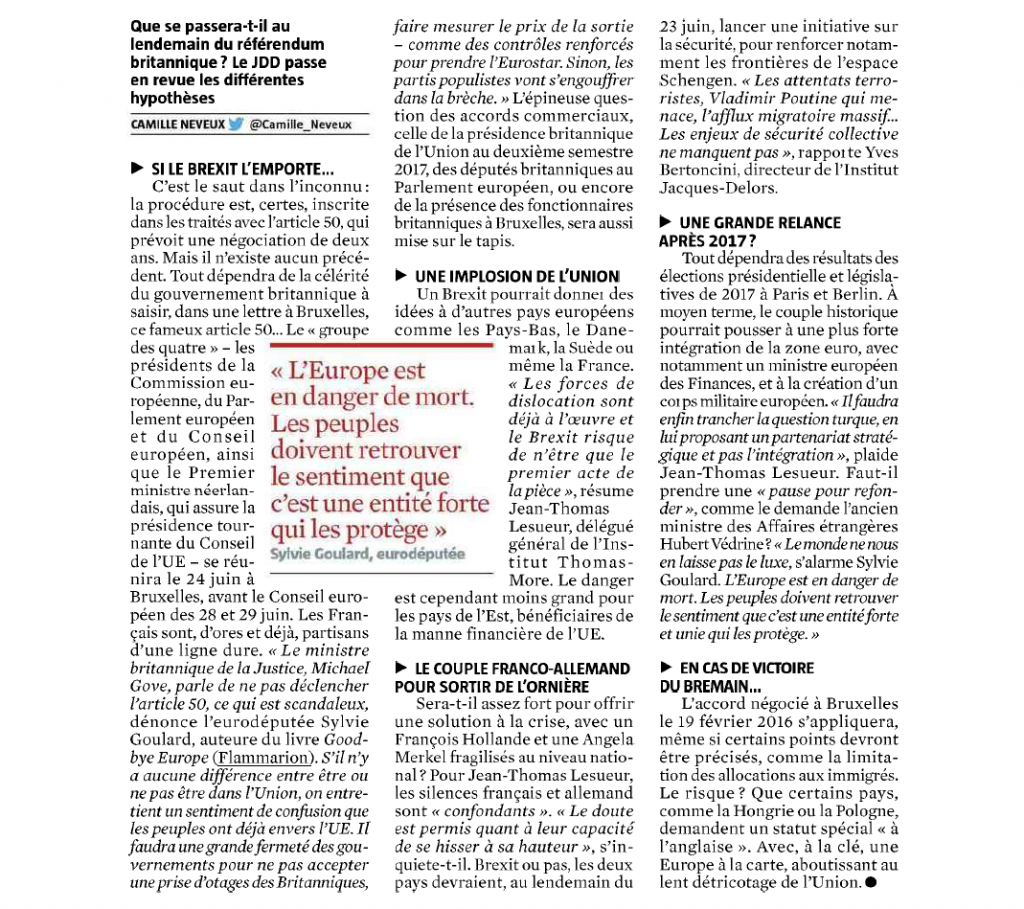
    Peu après le référendum sur le Brexit, j’ai alerté dans le Journal du Dimanche sur le danger mortel qui pèse sur l’Union européenne. L’Europe est en danger de mort. Les peuples doivent retrouver le sentiment que c’est une entité forte qui les protège. Sans une relance ambitieuse, notamment franco-allemande, nous risquons l’implosion ou une sortie chaotique de l’Union.

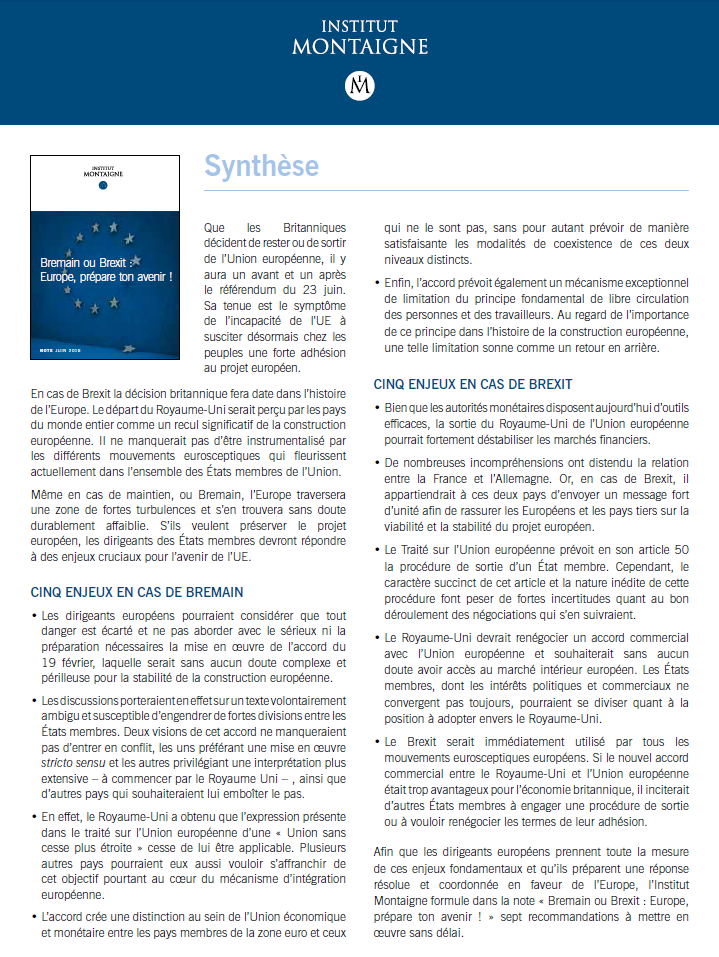
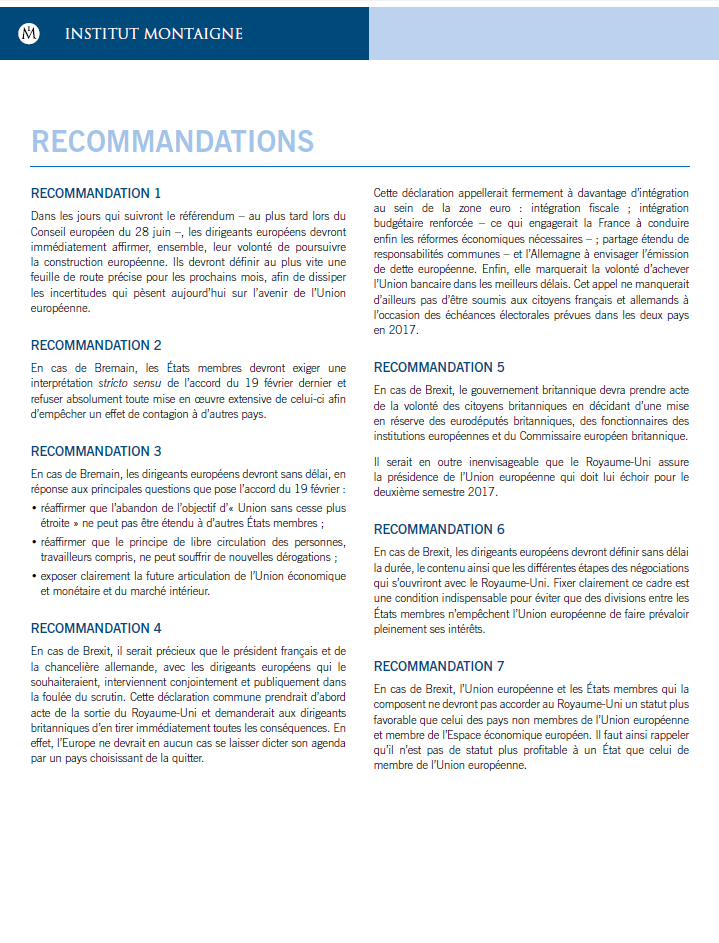
  • Note de l’Institut Montaigne – Bremain ou Brexit : Europe, prépare ton avenir ! 20/06/2016

    Note de l’Institut Montaigne – Bremain ou Brexit : Europe, prépare ton avenir ! 20/06/2016

    A quelques jours du référendum britannique, l’Institut Montaigne appelle les responsables politiques à déployer urgemment une action ferme et coordonnée quelle que soit l’issue du vote.


  • Rassegna stampa : Gli errori dell’Europa e il rischio Brexit – Il Sole 24 ore 19/06/2016

    Rassegna stampa : Gli errori dell’Europa e il rischio Brexit – Il Sole 24 ore 19/06/2016

    Supponiamo per un attimo che gli inglesi il 23 giugno decidano in maggioranza di lasciare l’Unione europea. La reazione di primo acchito è prevedibile. I governanti nazionali si premureranno di rassicurare i loro cittadini sulla stabilità dell’Europa, ma non riusciranno a celare le loro preoccupazioni sul futuro dell’integrazione comunitaria. I mercati saranno scossi dalla paura di una prossima disintegrazione dell’Unione. Dovremmo temere per l’Italia, sempre segnata dal suo elevato debito pubblico? Nel suo ultimo libro, Sylvie Goulard, una europarlamentare liberale francese, non risponde a questa specifica domanda. Ma in Goodbye Europe non nasconde i suoi timori per il futuro dell’Unione, al di là del successo o meno di coloro che in Gran Bretagna vogliono l’uscita dalla Ue. Il libro della signora Goulard ha il merito di guardare con lucidità agli errori dell’Europa; di smentire con abilità gli stereotipi sulle debolezze dell’Unione; di rifuggire dalla retorica di molti suoi colleghi, preferendo l’analisi dei fatti alle dichiarazioni di principio. Tre gli spunti più interessanti.

    Il primo è relativo all’accordo siglato con il Regno Unito, e che sarà messo al voto degli inglesi. I trattati prevedono che «l’Unione europea crea una unione economica e monetaria la cui moneta è l’euro». L’intesa firmata tra i Ventotto in febbraio stabilisce invece che «non tutti gli stati membri hanno l’euro come moneta». Nei fatti, la deputata nota il grave paradosso che si è venuto a creare: «La valuta non è più unica, l’esenzione (accordata alla Gran Bretagna, ndr) non è più transitoria, ma i deputati europei, i commissari e i giudici britannici continueranno a prendere parte alle decisioni relative a una zona euro alla quale il Regno Unito dichiara non voler mai aderire».

    Sempre agli occhi della signora Goulard non è vero che l’Unione toglie sovranità ai cittadini europei. Anzi restituisce loro sovranità. Due gli esempi citati nel libro. Prima dell’euro, l’inflazione era alta e le svalutazioni frequenti. Oggi, la moneta garantisce dopotutto il suo valore d’acquisto. L’altro esempio riguarda una sentenza recente della Corte europea di Giustizia che ha messo un limite alle violazioni della privacy di Facebook. «Nessun Paese europeo da solo – nota la parlamentare europea – avrebbe potuto incitare gli Stati Uniti e rivedere le sue regole». Infine, l’ultimo spunto riguarda l’assetto istituzionale dell’Unione, reso ancor più fragile dal paradossale potere concesso a Londra nell’accordo di febbraio. È evidente che la crisi economica, sociale e politica che attraversa l’Europa è anche il frutto di un sistema costituzionale ormai impossibile da gestire a 28. Non più totalmente confederale, ma neppure sufficientemente federale, il processo decisionale lento e farraginoso contribuisce a scelte poco efficaci e mal comprensibili. In questo senso, la signora Goulard è convinta che «se necessario, un gruppo di Stati europei deve avanzare da solo, senza aspettare chi esita».

    Questa strada appare tanto più indispensabile per contrastare il virus dei nazionalismi, di cui neppure l’Italia è certo immune. A proposito di come sia facile manipolare il patriottismo, la signora Goulard cita Hermann Göring, intervistato durante il processo di Norimberga dallo psicologo americano e germanofono Gustave Gilbert: «È sempre molto semplice trascinare il popolo, sia in una democrazia che in una dittatura (…) Basta dirgli che è attaccato, e di denunciare i pacifisti, notando che mancano di patriottismo e che mettono il loro Paese in pericolo (…) L’effetto è lo stesso in tutti i Paesi».

    di Beda Romano, 19 giugno 2016

  • Brexit et maintenant ?

    Brexit et maintenant ?

    Le téléphone sonne, 17 juin 2016, présenté par Nicolas Demorand.

    La Grande-Bretagne sort de l’Union européenne. Les dirigeants européens se réunissent pour organiser la suite. Quel scénario est à prévoir ? A quoi devons-nous nous attendre ?

  • Revue de presse : Goodbye Europe cité par Jacques Munier sur France Culture

    Revue de presse : Goodbye Europe cité par Jacques Munier sur France Culture

    Pour faire court, ce qui coince au Royaume Uni, c’est l’affaire du plombier polonais

    Et pourtant dieu sait combien nos réticences hexagonales à son égard furent moquées outre-Manche. Comme le rappelle Alain Frachon dans Le Monde, « Longtemps, il y eut des Polonais heureux ou bienvenus à Londres ». Après la chute du Mur de Berlin, la Grande-Bretagne militait pour l’élargissement de l’Union à la dizaine de pays libérés du joug soviétique – dont la Pologne – avec des arguments libéraux « d’inspiration très ” anglo-saxonne ” : liberté de circulation et d’installation des ressortissants des pays membres au sein de l’UE, de circulation des biens, capitaux et services ». Aujourd’hui, une majorité de Britanniques trouve qu’il y a trop de plombiers polonais, roumains ou lituaniens dans le pays. « Il faut reprendre la main sur la plomberie nationale, disent les chefs de la campagne Leave. Le référendum du 23 juin est un vote sur l’immigration. » Peu importe que dans l’ensemble, comme le rappelle The Observer, l’immigration ait eu un impact positif sur l’économie. « Localement elle peut être ressentie différemment. La perception compte autant que la réalité » et l’économie appartient à l’argumentaire du Remain. Reste que nombreux sont ceux qui voient dans l’immigration « l’une des causes de la pression à la baisse sur les salaires, donc de la stagnation des revenus » et qui lui imputeront dans les écoles « des classes surchargées, des listes d’attente à l’hôpital (même si le service de santé ne fonctionnerait pas sans les immigrés), le surencombrement et la dégradation des services publics ». Un paradoxe est souligné par Jan-Werner Müller dans l’hebdomadaire Le un : « la Grande-Bretagne envisage de quitter l’Union alors que celle-ci a été refaçonnée selon ses vœux ». Professeur de théorie politique à l’université de Princeton, cet historien allemand rappelle que « même Margaret Thatcher œuvra avec enthousiasme aux côtés de Jacques Delors à la réalisation du marché unique ».

    Sylvie Goulard, députée européenne, lui emboîte le pas dans L’Obs en dénonçant les faiblesses de l’Union dans l’accord conclu en février dernier en dehors du cadre des traités, sans débat au Parlement et dans l’opacité la plus totale : « on veut garder le Royaume-Uni mais on n’est pas prêt à tout accepter – devrions-nous affirmer haut et fort au lieu d’agiter la menace. Lorsqu’ils nous ont dit qu’ils voulaient réduire leur participation au projet communautaire, qu’ils ne voulaient pas d’une union sans cesse plus étroite, pourquoi ne leur avons-nous pas répondu : réduisons le rabais sur votre contribution au budget dont vous bénéficiez depuis Thatcher ? » Dans un livre au titre trompeur – Goodbye Europe – l’eurodéputée centriste invite à aller de l’avant sur trois fronts prioritaires : la défense, l’immigration et la monnaie. Car s’il est exclu de former un noyau dur à six – les pays fondateurs – si romantique que paraisse la reconstitution d’un empire carolingien, il y a une forte probabilité d’intégration plus poussée de la zone euro – à dix-neuf, donc. Un scénario qui aurait l’avantage de laisser en marge des pays qui ont choqué, ces derniers mois, par leur repli égoïste, liberticide ou xénophobe, estimait hier Karl De Meyer dans Les Échos

    Kenneth White, l’inventeur de la géopoétique retrace quant à lui dans Le un les tribulations de l’idée Europe

    Le mythe fondateur de la princesse phénicienne enlevée en Crète par Zeus déguisé en taureau blanc nous dit ce que l’Europe doit à l’Asie (c’est Cadmos, le frère d’Europe, qui aurait apporté en Grèce l’art de l’écriture), et en même temps son intention de recommencer à neuf. De grecque l’idée devient romaine : « On quitte la légende pour les légions. Une unité devait se faire, manu militari. On pousse la frontière, la limite, le limes, de plus en plus loin. Jusque chez les Calédoniens, en Écosse, par exemple. Un chef celte s’écrie : « Ils font un désert et ils appellent cela la paix. » La pax romana était violente. Mais elle a cependant apporté des bienfaits : des livres, du vin – et une langue universelle. » Et l’écrivain d’origine écossaise de faire l’inventaire de l’apport de son pays à l’Europe, Lumières comprises : « les moines fondant monastères, écoles, bibliothèques : à Luxeuil en France, Saint-Gall en Suisse, Bobbio en Italie… Un mouvement poursuivi par Scot Érigène au IXe siècle ; par Duns Scot au XIIIe siècle ; par George Buchanan au XVIe siècle, grand humaniste, maître en langues et en littérature de Montaigne ; par David Hume au XVIIIe siècle, philosophe radical, parfaitement chez lui à Paris, ami des encyclopédistes, et qui, en Allemagne, réveilla Kant de son « sommeil dogmatique ». Alors peu importe le Brexit, Kenneth White a envie de dire « bon débarras », l’Europe s’est faite avant et sans l’Angleterre, elle lui survivra

    Par Jacques Munier