Pour retrouvez l’interview de Sylvie Goulard, cliquez ici (émission du 23/05, de 7h à 8h, à partir de la 35e minute).
Auteur/autrice : julien
-
Bourdin direct sur RMC
Pour retrouvez l’interview de Sylvie Goulard, cliquez ici (émission du 23/05, de 7h à 8h, à partir de la 35e minute).
-
Agora sur France Inter – Dimanche 22 mai 2016 – Comment l’Europe va-t-elle changer ?
Comment l’Europe va-t-elle changer ?
dimanche 22 mai 2016
Avec Sylvie GOULARD, député européenne ADLE, membre de la commission des affaires économiques et monétaires et Etienne BALIBAR, philosophe, professeur émérite à l’Université Paris-Ouest
-

Les Echos – Brexit et bien-pensance
Les âmes bien-pensantes se sont naturellement émues des propos tenus par Jean-Claude Juncker à la veille du week-end sur les conséquences d’un Brexit. « Les déserteurs ne seront pas accueillis à bras ouverts. Si les Britanniques devaient dire “non” […] , le Royaume-Uni devra accepter d’être considéré comme un Etat tiers, que l’on ne caressera pas dans le sens du poil », a lancé le président de la Commission de Bruxelles. Quelle maladresse ! Cela va donner du grain à moudre au camp du non lors du scrutin du 23 juin, a murmuré le Tout-Europe – comme il y a le Tout-Paris. Ajoutant in petto : un sacré gaffeur, ce Juncker, lui qui s’était déjà illustré en lançant à mi-voix lors d’un sommet européen à l’arrivée du Premier ministre hongrois : « Le dictateur arrive ! » Admettons que la charge soit un peu lourde et peu subtile. Mais il convient alors, par simple honnêteté, de juger sévèrement la légèreté avec laquelle les Britanniques se soucient comme d’une guigne de ce que pensent les autres Européens. Dans un essai revigorant (*), la députée européenne Sylvie Goulard rappelle que David Cameron a refusé de participer à un simple débat public au Parlement européen. C’est inadmissible : son pays est membre depuis 1973 de l’Union et les représentants élus des vingt-sept autres peuples n’ont même pas droit à une explication ? La vérité est que le Brexit ou le Brexin concerne tout le continent et que la discrétion des dirigeants européens sur le sujet est peut-être de bonne tactique, mais elle est de mauvaise politique. En définitive, que retiendront les opinions publiques ? Que c’est Barack Obama qui aura été le plus clair, en allant défendre le Remain sur le sol britannique. What a shame !
* Sylvie Goulard – Goodbye Europe, Flammarion
Dominique Seux
-

L’Europe doit s’élever à la hauteur des défis
Tribune par Franziska Brantner, Laurent Cohen-Tanugi, Daniel Cohn-Bendit, Henrik Enderlein, Hervé Gaymard, Sylvie Goulard, Elisabeth Guigou, Anne-Marie Le Gloannec, Thomas Oppermann, Norbert Röttgen et Lieven De Winter.
Les 28 États membres de l’Union européenne (UE) sont mis à l’épreuve par la crise des réfugiés, la crise économique et monétaire qui génère un chômage des jeunes massif et persistant, par les guerres et les conflits qui secouent ses voisins. Aucun de ces défis ne peut être relevé par un État isolément ; chacun d’entre eux somme les États d’être solidaires. Il est donc crucial de surmonter la crise de solidarité qui paralyse l’Europe actuellement. Dans un contexte difficile, les accusations entre États fusent de toutes parts. La situation est pourtant trop grave pour perdre du temps en récriminations. Nous voulons aller de l’avant ensemble. Nous en sommes persuadés : il faut embrasser ces défis d’un seul regard. Il ne saurait y avoir de solidarité partielle. Ce n’est que dans une perspective globale que la solidarité pourra prévaloir et que des solutions pourront se dessiner. Et c’est sur la force de la coopération et de la compréhension franco-allemande que repose tout progrès.
Cet appel initié par des acteurs politiques et académiques allemands et français est paru le 17 mars dans Les Échos, la Frankfurter Allgemeine Zeitung et le Financial Times.
-
The United Kingdom/The European Union: a clarified relationship or a fool’s bargain?
The United Kingdom’s (UK) geopolitical weight, its economic and financial power, as well as its commitment to democracy and an open economy justifies significant efforts being made to ensure that the country remains a member of the European Union.
However the United Kingdom’s future relationship with the European Union concerns all the Member States and their peoples. The clarification exercise should remove the ambiguities which have characterised the relationship for decades. Fairness calls for an agreement to be found where each member’s rights correspond to their accepted responsibilities. The people of one Member State should not be invited to express themselves, through a referendum, on a text whose legal scope is uncertain.
On 19th February in Brussels, Europe’s leaders concluded a “settlement under international law”, outside of the legal framework of the Union. This instrument is at the very least ambiguous
[1], and could potentially be a fool’s bargain. Justified by precedents with limited relevance[2], this choice hides how unbalanced the compromise is, to the detriment of the euro zone, and the extent to which the demands for democracy and economic competitiveness have been ignored.
Simply comparing the declarations made by François Hollande with those made by David Cameron after the European Council meeting shows the extent of the divergences.
1- A settlement of ambiguous nature
This settlement is sometimes presented as “an instrument for the interpretation of the Treaties[3]“, “fully compatible with the Treaties[4]“, sometimes as “legally binding[5]“.
It includes a certain number of harmless reminders (such as the mention of the principles of the conferral of powers, subsidiarity or the fact that each Member State is responsible for organising their national social systems, all of which are already enshrined in the Treaties). However many sentences are formulated in such a way as to mislead non-lawyers.
Some apparently binding commitments are nothing more than legally empty wishes and the rest are subject to a wide range of interpretations by the different parties.
Thus, the Heads of State or Government do not have the power to make firm commitments concerning future Treaty change, as is the case for example in Section C Sovereignty, with reference to the clause “ever closer union”.
Just after the European Council François Hollande clearly stated during the press conference that: “No revision of the Treaties is foreseen soon. And when they are revised, I do not know when that will be, the provisions which have been set out today will at that point be integrated during the revision. But from now until then there will be no revision of the Treaties, this was a position which I absolutely wanted to respect.” The commitment taken is immediately relativized.
For his part, David Cameron claims the opposite: “the Council was also clear that the treaties will be changed in 2 vital respects <…> for managing the relationship between countries inside and outside the eurozone and to carve the UK out of ever closer union[6]“.
The limits of constructive ambiguity seem to have been reached.
Nor are the Heads of State or Government able to prejudge changes to legislation. For example, the settlement foresees the pledge of the European Commission to propose changes to the legislation concerning the social benefits received by intra-EU migrant workers, which concern both the exportation of child benefits and non-contributory in-work benefits. The European Parliament will however retain the right to decide how it votes on the legislation; thus it is not possible to pre-definite the content of that legislation, which will be decided on an equal footing with the Council of Ministers.
Concerning financial services the difference between François Hollande’s interpretation and David Cameron’s is striking. For the French President, “I do not want there to be different rules for the financial centre of London, in comparison to other places in the European Union“; on the contrary he wishes “that the same rules are applied with the same controls, with the same bodies and the same authorities to verify their application.” This seems to be perfectly in line with what a single Internal Market would be.
For David Cameron on the other hand, “responsibility for supervising the financial stability of the UK remains in the hands of the Bank of England.”
Finally, the introduction of a “brake” which national Parliaments[7] could activate to block the adoption of European legislation cannot be considered as inconsequential. Through this settlement[8] the European Council confers power to the Council of Ministers to “discontinue the consideration of the draft legislative act” even though the legislative power, as explained above, is held by two branches, the Council of Ministers and the European Parliament. Protocol 2 annexed to the Treaties gives national Parliaments the right to raise the alarm but not more. In the settlement, the desire to block has prevailed over the desire to construct.
The fundamental question of whether or not democratic control should be European or mixed (the involvement of national Parliaments in European legislation), deserves much deeper examination.
Treaty change, via the back door, while claiming the opposite, is not good practice. The existence of the Union’s own legal system which creates direct rights for businesses and citizens, pursuant to the jurisprudence of the European Court of Justice (26/62 Van Gend en Loos)[9], is not an abstract question intended only for lawyers.
2- The concrete consequences for citizens and businesses
The choice of a settlement under international law[10] represents a regression because, since the creation of the European Community, a particular importance has been given to the creation of an “integrated legal system” expressly not based on international law.
The legal consequences of the 19th February settlement remain, at this stage, very ambiguous concerning citizens and economic actors. For example they could concern a national from one Member State deprived of his social rights in the United Kingdom. Only the Court of Justice can ultimately determine the scope of the settlement.
Likewise a financial company affected by a British law created, in the name of financial stability, in opposition to the common legislation adopted by 28 Member States, could also take the issue in front of the court because following the financial crisis a considerable amount of legislation has been created at the European level in order to avoid fragmentation. The final drafting of the settlement is better than the initial proposal by Donald Tusk but it still contains some uncertainties about which only the Court of Justice can ultimately decide[11]. This remains the case, irrespective of Donald Tusk’s statement to the contrary in the European Parliament: “The decision concerning a new settlement is in conformity with the Treaties and cannot be annulled by the European Court of Justice.[12]”
The Heads of State or Government should not conclude settlements which are so confused and which rely on judges to protect the common framework.
The agreement concluded to the advantage of only one Member State, the United Kingdom – because it is powerful and threatened to leave – tends to deny the fundamental principle that there is one set of rules for everyone. Or, if the settlement is an empty agreement, then it is nothing but a fool’s bargain.
After analysis it seems that far from discriminating against the British it has instead been concluded to the detriment of the euro zone.
3- Discrimination against the euro zone[13]
The relations between the Member States of the European Union are based on the Treaties signed and ratified by all parties[14]. In these Treaties the United Kingdom formally accepted the following rule: “The Union shall establish an economic and monetary union whose currency is the euro” (article 3(4) TEU).
A single currency requires a single institutional framework. This is why British MEPs who sit in the European Parliament, British judges at the Court of Justice or the Commissioner coming from the United Kingdom participate fully in all decisions concerning the euro zone.
Since Maastricht, the Treaties have been asymmetric, in favour of the UK[15]; at that time it was understood that one day all Member States would join the euro[16]. It was thus not considered necessary to duplicate the institutions for a situation which was meant to be temporary. In the 1990s Tony Blair was still promising a referendum on joining the euro.
In this settlement a fact is recognised: “not all Member States have the euro as their currency[17]“. This may appear harmless, as the United Kingdom has in fact kept the pound, however this mention actually represents an important legal change. David Cameron claimed victory during his press conference: “for the first time, the EU has explicitly acknowledged it has more than one currency“.
The settlement under international law concedes that there is no longer a single currency without taking into account the institutional consequences: there is still only one decision making framework.
The relevant passage in the settlement clearly illustrates the ambiguity: “Member States not participating in the further deepening of the economic and monetary union will not create obstacles to but facilitate such further deepening while this process will, conversely, respect the rights and competences of the non-participating Member States[18]” (Underlining is an addition).
If the British maintain “the rights and competences” which they have in accordance with the Treaties then they retain a full role within the institutions (Parliament, Commission, Court), including their voting right and decision making concerning subjects which only concern the euro zone. The day that future revision takes place, which will require unanimity, they will also have the right to make certain demands, even block the deepening of the euro zone.
The French Head of State claimed, during his press conference, that “there is no veto for the United Kingdom concerning the euro zone” and also “what I do not want is that the United Kingdom could block, thwart or restrict the further deepening of the euro zone or to have derogations from the common rules“, the legal content of the settlement seems to prove the opposite.
It is possible that a future British government will keep their word and not oppose the necessary deepening of the euro zone, which is largely in the UK’s interest. If however, under pressure from public opinion or from the City, the most rigorous legal interpretation should prevail, the other Member States would not be able to object. The negotiations which have just been concluded confirm, if it was necessary, that the British do not play games with issues which they consider to be their national interest.
Under the settlement, the UK is accorded an even more exceptional status than the one it already enjoys. On the one hand, while strongly reaffirming that “we will never join the euro[19]“, David Cameron still managed to secure that British MEPs, Commissioner and judges will continue to take part in all decision making concerning the euro zone; the country also retains its right to oppose all future formal Treaty revisions, including on provisions concerning the euro zone.
On the other hand, the UK is expressly exempted from contributing in any way to a euro zone emergency fund and has the power to ask the European Council to re-examine, during the legislative procedure, a draft text concerning banking union[20][21].
This final measure (open to any Member State not in the euro zone) is particularly inappropriate: it could result in the legislative process concerning the banking sector being slowed down, by “referring” technical dossiers to the European Council. It is necessary to recall that under the Treaties the European Council “shall not exercise legislative functions“. (Art 15(1) TEU).
The British government is free to take the sovereign decision not to adopt the single currency. However, this means that we are no longer in a temporary situation, as was the case up to now. One can ask why did the Heads of State or Government not seek a formal modification the Treaties in order to formalise this decision and to align the rights and responsibilities of each Member State?
This is a badly constructed settlement, adopted without public debate, contrary to the minimum required to ensure democracy.
4- An undemocratic procedure
The United Kingdom’s membership of the European Union concerns all Europeans. As has just been illustrated, the settlement includes choices which warrant discussion. Instead it was concluded behind closed doors and the subject continues to be treated as one that only concerns the British.
This asymmetry risks creating new frustrations in public opinion. Once again, as when it opened accession negotiations with Turkey without any public debate in 2004, or when it managed the crisis of the euro zone behind closed doors, the European Council is not very interested in the citizens of Europe.
With a disregard for the ambitions of the Founding Fathers of the Union[22] the leaders treat the Union like an alliance of states, making the requirements of democratic consent disappear, and the diverging claims of the signatories of the settlement are puzzling. No-one should then be surprised, in the midst of such confusion, that euro scepticism, and even doubts about Europe amongst those who are pro-European, are increasing.
The European Union’s institutions have been reduced to taking part in opaque dealings. This work has undoubtedly enabled the first draft published by Donald Tusk[23] to be improved, but only marginally, because the starting point (settlement under international law) was to take or leave.
The Commission has not played its traditional role of Guardian of the Treaties (art 17 TEU) because it has accepted recourse to an uncertain instrument which interferes with the Treaties.
Even though the issue was fundamental – the potential departure of a Member State, and not just any Member State – the European Parliament did not organise a public debate before the European Council meeting. The participation of three MEPs and President Martin Schulz[24] in negotiations with the staff of the Heads of State or Government, without a clear mandate from the plenary, does not replace a debate in the plenary nor voting on a resolution.
David Cameron refused to come and speak in front of the plenary, illustrating his lack of respect for this institution. The European Central Bank, whose opinion would have been published in the case of formal Treaty revision, has not been able to enlighten citizens and policy makers about what is at stake.
The decision to resort to a settlement under international law has resulted in the institutions being sidestepped. At the end of these negotiations there is not much left of the rule-based EU.
Irrespective of whether it was intended, it has also placed the national Parliaments of the 27 partner countries on the periphery, even if modalities concerning ratification lie with the constitutional law of each Member State.
Finally, the agreement contains an unprecedented feature: it will “cease to exist” if the British people decide, by referendum (which will take place on 23rd June), to leave the European Union. It would be even stranger to leave this Member State to decide alone the appropriateness of the settlement, given that, if the British decide to stay in the Union, it will enter into force with non-negligible consequences for the euro zone, as for EU nationals living in the UK or non-British banks and financial actors based in London.
5- Competitiveness forsaken
This final point is far from minor. Limiting itself to recalling previous general declarations, the settlement does not include serious measures intended to strengthen the competitiveness of the Union’s economies, nor the Internal Market, even though in fields such as digital or services Europe is lagging behind.
This was a missed opportunity to respond to one of the UK’s most justified demands. The fact that David Cameron is satisfied will not be enough to revive Europe’s stagnant economies.
This shortcoming shows to what extent the Heads of State or Government ultimately prioritise small agreements between themselves over decisions concerning the real world. When they meet the state of the economy, unemployment and the problems experienced by businesses in order to be able to work across borders are considered to be secondary.
Conclusion
After the European Council, the President of the French Republic and David Cameron present opposing analyses of the settlement which they have just concluded.
Given the extent of the ambiguity, the settlement concluded on 19th February cannot be considered to be a clarification. Certain aspects affect the interests of France and the euro zone. It certainly muddies the clarity of the Community legal order.
Before 23rd June, date of the British referendum, a public debate must take place in front of national Parliaments, including the French Parliament, in order to assess whether or not the instrument chosen is acceptable and if, given its nature, the settlement is balanced.
The national Parliaments cannot have their scrutiny right withdrawn after the European Parliament, as an institution, has already been side-lined.
Ultimately, it will probably become clear that the only unambiguous solution for both the United Kingdom, and its partners, required to ensure a sound future relationship, will be a formal revision of the Treaties, foreseeing, for the United Kingdom (and others as the case may be) rights which correspond to the commitments which it is prepared to take.
[1] For a more complete study see for example the document drafted by independent experts from the Erasmus University Rotterdam for the Directorate General for Internal Policies, Policy Department C: Citizens’ Rights and Constitutional Affairs, with regard to the renegotiations with the United Kingdom.
[2] Legal Counsel of the Council (8th February 2016, JUR 64). In 1992 (Denmark) and 2009 (Ireland), it was a question of giving specific reassurances to peoples who had rejected a Treaty. The concessions did not have the same impact on the legislation adopted (here in the fields of financial services or free movement) and did not create additions to the Treaty, (in this case the unprecedented involvement of national Parliaments in the legislative procedure).
[3] EUCO 1/16, Annex I, paragraph 3
[4] EUCO 1/16 1, 2
[5] EUCO 1 / 16, I. 3. (iii)
[6] Prime Minister’s Statement following the European Council meeting, 19 February 2016
[7] Representing 55% of the votes allocated to the national Parliaments, within a deadline of 12 weeks
[8] § 3 section C “Sovereignty”
[9] This judgement stipulates that: “the Community constitutes a new legal order of international law for the benefit of which the states have limited their sovereign rights, albeit within limited fields, and the subjects of which comprise not only Member States but also their nationals.”
[10] Which the British insist on tabling at the United Nations…
[11] The settlement itself refers to the European Court of Justice to interpret the limitations concerning free movement
[12] Donald Tusk, Plenary session 24 February 2016
[13] When referring to the euro zone the reasoning is that it also includes the Member States who are committed to joining (26 out of 28 Member States)
[14] Since 2009, the date of the last formal revision, Treaty on European Union, Treaty on the Functioning of the European Union, accompanied by various protocols
[15] And Denmark, the two Member States who have opt-outs.
[16] As Protocol 14 on the eurogroup illustrates
[17] EUCO 1/16, annex I, paragraph 4
[18] EUCO 1/16, Annex I, Section A Economic Governance, §2
[19] Prime Minister’s Statement following the European Council meeting, 19 February 2016
[20] EUCO 1/16, Annex II, banking union agreed only between euro zone Member States
[21] In the most recent MMF agreement (2014 – 2020) France contributes EUR 1.6bn annually to the UK rebate (EU’s largest contributor) and Italy contributes EUR 1.2bn. If this rebate was justified when Margret Thatcher was Prime Minister, this is no longer the case.
[22] “We are not uniting states, we are uniting people”, Monnet
[23] Published 2nd February, EUCO 4/16 – EUCO 9/19
[24] The EUCO 1/16 settlement makes reference to their participation “having taken into account the views expressed by the President and members of the European Parliament”.
-
A brief insight into the Vote Leave campaign
How to scare, or how to ignore risks
No-one could say that the campaign has not sparked passions on both sides of the table, however the Vote Leave campaign has sometimes clearly exaggerated.
A few examples:
- When Boris Johnson likened the European project to Hitler’s plan for a superstate:
“Napoleon, Hitler, various people tried this out, and it ends tragically. The EU is an attempt to do this by different methods.”
- The claim that EU enlargement is imminent and the inhabitants of these countries all then plan to flock to the UK:
“Albania is on course to join the European Union — alongside four other countries, Macedonia, Montenegro, Serbia and Turkey. The already unwieldy group of 28 is due to become a throng of 33… When Albania, Macedonia, Montenegro, Serbia and Turkey join the EU, another 88 million people will soon be eligible for NHS care and school places for their children. And what will even more immigration from the EU mean for access to housing across the UK? How many more homes will we need and how many more green acres will go? What will it mean for jobs and wages?”
Many elements of the Vote Leave campaign propagate untruths, some of which could be very damaging.
- It is astounding that the UK’s Northern Ireland Secretary can be so dismissive of the risks which Britain leaving the EU could imply for the peace process, including the issue of reinstating border controls between the Republic of Ireland and Northern Ireland, as this border would become an external border of the EU. All other external borders of the EU have border controls. For many the memories of the IRA terrorist attacks of the 1980s and 1990s are still very fresh, as are those of how difficult it was to reach the Good Friday Agreement.
Teresa Villiers says claims that Britain leaving the EU could destabilise the peace process in Northern Ireland are purely “scaremongering of the worst and most irresponsible kind”.
http://www.ft.com/intl/cms/s/0/858fa0f0-0184-11e6-ac98 3c15a1aa2e62.html#axzz49mQvilMSIt is also remarkable how often the UK contribution to the EU budget has already been spent.
How to spend it © FT : )
- The number of times over that the ‘Brexit’ campaign intend to spend the money currently given to the EU budget:
Michael Gove, 19 April 2016:
It could be invested in new infrastructure, apprenticeships and science.
It could be deployed in our NHS, schools and social care.
It could pay for tax cuts, enterprise allowances and trade missions.
It could pay for 14 Astute Class submarines.
It could enhance this nation’s security, productivity, social solidarity and competitiveness.
- Vote Leave’s claim that the EU costs the UK 350 million pound, forgetting to take into account the UK’s rebate, one of Margaret Thatcher’s lasting legacies to the UK’s contribution to the EU!
For those who would like more information about the claims made by both sides in the referendum campaign https://fullfact.org has a lot of very useful information.
-
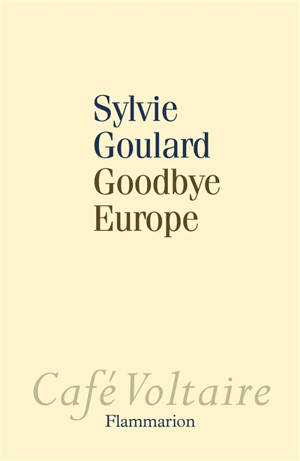
Goodbye Europe, Flammarion “Café Voltaire”, mai 2016
Comme l’a écrit Emmanuel Beretta dans Le Point, « il ne faut pas se laisser abuser par le titre de cet essai, « Goodbye Europe ». Sylvie Goulard ne souhaite pas la disparition de l’Europe politique, mais sa renaissance. »
Le référendum que le gouvernement britannique organise le 23 juin prochain, à propos de l’appartenance du Royaume-Uni à l’Union européenne, nous tend en réalité un miroir où se reflètent nos propres doutes et faiblesses.
Il ne fait pas de doutes que le départ de ce pays affaiblirait l’Union européenne : elle perdrait une démocratie de premier plan, un partenaire géopolitique majeur, une économie dynamique et ouverte ainsi que la première place financière mondiale. Un précédent serait créé qui, par effet domino, pourrait enclencher un délitement. Mais l’accord international auquel sont parvenus nos chefs d’États ou de gouvernement le 19 février dernier illustre crûment les errements de l’Europe actuelle: les dirigeants européens « prétendent retenir le RU dans l’Union par le reniement de ses règles et le sacrifice de sa substance. Est-ce le RU qui la quitte ou tous l’ont-ils déjà abandonnée ? ».
Lire la suite
Une erreur psychologique a été faite: « Personne ne semble s’être posé la question de savoir si la meilleure manière de retenir les Britanniques était vraiment de céder à toutes leurs demandes. A Bruxelles, l’idée s’est répandue qu’il était impossible de leur refuser quoi que ce soit. C’était accepter de se soumettre à ce qu’il faut bien appeler un chantage, alors même que l’Union européenne repose sur le principe de « coopération loyale » inscrit dans les traités.
C’est d’autant plus regrettable que certaines des demandes de David Cameron, par exemple celles visant à renforcer l’efficacité de l’Union et sa compétitivité dans la course mondiale, étaient fondées. Son invitation à réformer la gouvernance de l’euro aurait également dû être entendue car, quelle que soit la décision des Britanniques, le statu quo n’est pas tenable.
« Le drame, ce n’est pas la force du Royaume-Uni, c’est la faiblesse de ses partenaires. Le drame, c’est le manque d’élan et d’imagination, c’est le silence de la France, de l’Allemagne, des autres pays fondateurs, des institutions et de tous ceux qui, par le passé, ont apporté leur pierre à l’édifice commun et s’en désintéressent aujourd’hui ».
L’arrangement du 19 février dernier est ambigu. Pour le gouvernement britannique, c’est un accord international contraignant justifiant l’organisation d’un référendum et son dépôt aux Nations Unis. Pour les autres Etats membres, c’est un texte interprétatif ne réclamant pas même un passage devant les Parlements nationaux.
« Les conditions de l’appartenance d’un Etat à l’Union ont été fixées par un arrangement de droit international comme les Etats européens pourraient en conclure avec le Nicaragua ou le Zimbabwe. (…) Les chefs d’Etat et de gouvernement ont même inventé la première éponge double face du droit international » avec « un côté rugueux pour gratter les doutes anglais et permettre à David Cameron d’organiser son référendum et un côté tout doux pour ne pas effrayer François Hollande ».
Cet accord promet des changements ultérieurs des traités et des modifications de législation sur des points fondamentaux : l’objectif de construire une « union sans cesse plus étroite » serait abandonné ; une interférence accrue serait accordée aux Parlements nationaux dans la procédure législative européenne, au risque de l’entraver ; à la liberté de circulation, des limitations de prestations seraient opposées. Ces changements n’ont donné lieu à aucun débat. Ils accordent au RU un statut encore plus à part, au mépris des engagements qu’il avait antérieurement pris.
Quelle que soit en définitive la décision souveraine des Britanniques, la France, l’Allemagne et les autres pays de l’Union doivent tout aussi souverainement élaborer une vision d’avenir.
« Nous ne pouvons plus progresser dans la construction européenne à tâtons, comme des somnambules, sans définir ensemble, par un débat démocratique transfrontière, dans quel type de société nous voulons vivre. »
Souvent les défaillances imputées à l’Union européenne sont le reflet d’un bouleversement plus vaste, à l’échelle du monde. C’est pourquoi la nostalgie du « retour au Franc » ou de la souveraineté nationale retrouvée, ne sont que des illusions. La mondialisation crée des interdépendances nouvelles et relativise le territoire. Dans ce contexte l’instrumentalisation de la nation et de la chrétienté à laquelle se livrent des « patriotes » auto proclamés, est scandaleuse.
« Plus que le partage de souveraineté consenti dans l’Union européenne, c’est le grignotage sournois dû au bouleversement du monde qui réduit les marges de manœuvre des pays. L’Union européenne, au contraire, nous restitue de la souveraineté. »
Des élections majeures se tiendront en France et en Allemagne en 2017. C’est l’occasion de définir ce que nous voulons faire de l’Europe et de s’atteler à la reconstruire.
Main ideas in english
It is of the outmost importance to keep the UK in…
- Brexit would be costly and negative for the UK, as well as for the EU
- Geopolitical reasons: division of the West is dangerous (US/Canada clearly against Brexit); fragmentation would please Putin
- Economic reasons: pro-business, open country/driving force for the Single Market and trade agreements
- Historical and democratic achievements of the UK
But a sound legal basis is essential
- On 19 February, international agreement made between the 28 Member States, outside the EU Treaty framework; ambiguous nature; circumvents Treaty revision procedures; the Commission should have objected; no debate in national parliaments/no debate/vote in the EP
- Legally binding or interpretative? Nobody knows; agreement deposited by the UK at the UN/no ratification in the national parliaments of the other Member States
- Opaque promises of Treaty changes, as well as modifications to EU social legislation still to be confirmed; for example: to give blocking rights for national parliaments obviously requires Treaty change; bypassing legal framework of Treaties not appropriate/efficiency of EU legislative process reduced
Need fair ‘agreement’ for all – from a French/euro area perspective, the deal is unfair
- Until now, single set of institutions (1 EU Parliament/1 EU Commission) because the euro is the single currency of the whole EU (2 countries, including UK, having an opt out); if the UK definitively refuses to join the euro, it should have no right to participate further in decision making process
- Asymmetric concessions on sovereignty (“ever closer union” removed from Treaty); the UK has signed and ratified the Treaties which were the result of give and take
- No reason to give an outsider an emergency brake on Banking Union; settlement unclear on the Single Market for financial services; UK still Single Market oriented?
- If the UK manages to reduce its commitments, why should France (and Italy) still pay an unchanged contribution to the British rebate: EUR 1,6 billion a year (Italy EUR 1,2 billion)?
- ‘Agreement’ very weak concerning competitiveness
Cameron[1] was right on 3 points:
- the need to boost Europe’s competitiveness
- the need to reform the EU/deepen the euro area
- No British veto on any euro area reform, as the UK is outside
The EU leaders were not right:
- Taking the risk of destroying the EU/creating a dangerous precedent – to solve domestic problems in one country at the EU level; hazardous gambling
- Interpreting the Treaty as giving a government the right to blackmail its partners with the threat of leaving; art 50 of the EU only foresees the right to leave, certainly not to unilaterally obtain a special status
- Accepting the narrative that the UK is discriminated against concerning the euro area; it has not been put in a minority, it has made the sovereign choice not to join the euro, which is quite different
- Buying the argument that democratic accountability can only derive from national parliaments; the European Parliament has been directly elected since 1979 (UK committed member; excellent work of many British MEPs)
Conclusion
- Whatever the British people decide, deepening /democratizing the euro area should be the priority
- If the UK stays, need to clarify the future relationship EU/euro area: presidential election in France/federal election in Germany in 2017, opportunity to open a debate and get a popular mandate to renegotiate the Treaties (including concerning the UK’s role) which would offer a more balanced deal for all
- If the UK leaves
- need to respect the article 50 procedure (2 years/majority decision/consent of the European Parliament)
- consequences for the UK should be clear (no more Single Market, no passporting, clearing houses for euro transactions in the euro area)
[1] Bloomberg speech, January 2013
Questions-réponses sur le référendum
Dans les médias