
https://youtube.com/watch?v=ObYxh9wd0ws
https://youtube.com/watch?v=ObYxh9wd0ws


Sylvie Goulard: la moneta è il nostro scudo
«Naturalmente è troppo presto per dire oggi che linea seguirà l’America di Donald Trump. Ma noi europei dovremmo ribadire subito a Washington i valori che, al di là delle singole differenze, ci accomunano tutti, da Berlino a Roma a Parigi e a tutte le altre nostre capitali: il rispetto per le società aperte, le donne, gli immigrati, il rifiuto della pena di morte, i diritti degli omosessuali…».
Sylvie Goulard, eurodeputata francese dell’Alleanza dei liberali e democratici, autrice di libri come «Goodbye Europe» e (insieme con Mario Monti) «La democrazia in Europa», ammette apertamente di essere preoccupata per il risultato del voto americano.
Ma ricorda anche che l’Ue resterà per lo stesso Trump il primo mercato nel mondo, dunque non potrà ignorarla. Anzi, paradossalmente, «The Donald» potrebbe dimostrarsi una cartina di tornasole per rivelare indirettamente agli europei ciò che li unisce: «Un po’ come accadde ai padri dell’Europa quando si ritrovarono di fronte un’Urss che nella sua visione non rispettava certi valori: furono proprio loro, a schierarsi per il rispetto e la dignità delle libertà civili».
Non solo: se a Roma, Parigi o in altre capitali – dice ancora Goulard – «qualcuno si lamenta ogni tanto dei presunti diktat di Bruxelles, questo potrebbe essere il momento per ricordarci di quanto vale la nostra moneta comune, l’euro: perché domani, chissà, potrebbero arrivarci dalla Casa Bianca, dal Congresso, dalla Fed, dal Tesoro, altri diktat di ben altra potenza, e allora l’euro potrebbe rivelarsi come l’unico nostro vero scudo».
Il Trump che più dovrebbe preoccuparci? «Quello che, insieme con gran parte del suo partito repubblicano, mantiene posizioni arcaiche e irrazionali sulla protezione dell’ambiente, praticamente è rimasto nel secolo scorso» .
Luigi Offeddu – 12/11/2016
Dans cette tribune, Sylvie Goulard estime que le Royaume-Uni ne peut attendre que les 27 Etats membres abandonnent les principes fondamentaux de l’UE, que l’article 50 du Traité donne le droit à un Etat member de quitter l’UE et non de la transformer. Elle expose la dynamique historique qui a conduit à ériger les principes de base du marché intérieur. Personne ne peut préjuger de ce que l’Union européenne sera dans 10 ans mais deux facteurs peuvent transcender les querelles internes au sein de l’UE : la sécurité et le fait que dans un monde globalise la taille compte.
The High Court ruling on the role of parliament in taking Britain out of the EU has switched the focus to domestic matters. If Britain leaves the EU, the 27 remaining EU members will have to agree and the European Parliament will need to give its consent. The British cannot expect their partners to give up the core principles of the EU nor should the powerful dynamics that will shape tomorrow’s Europe be underestimated.
Article 50 foresees the sovereign right of a country to leave the EU, not to reshape it. Only the UK has held a referendum but public opinion in other countries is calling for changeand no one knows where that could lead. This situation creates a strong incentive for governments to maintain the status quo.
Furthermore, membership of the single market, which some UK politicians want, simply does not exist. The single market is based on supranational rules enforced by supranational institutions, especially the European Court of Justice. For many continental Europeans, the core objective goes significantly beyond a free market. Common values, enshrined in the Charter of Human Rights, and social and environmental standards are essential, as is a supranational budget. Even the governments of Hungary and Poland do not complain about cross-border transfers, worth respectively €19.5bn and €69bn from 2014 to 2020.
To allow any cherry-picking of the four freedoms — movement of people, goods, services and capital — would destroy the EU. The current balance is the result of decades of give and take: for example, the free movement of people to compensate eastern member states for western countries’ competitive advantage in goods and services. Labour mobility also contributes to an optimum allocation of resources. This is as true for scientific researchers as for carers of elderly people. The European Parliament will defend the four freedoms, keeping in mind that safeguards have been authorised by the European Court of Justice in case of abusive “benefit tourism”.
For historical reasons, as well as for the benefit of its remarkable export industry, Germany will not put the integrity of the single market in danger. Nor will France give up its vision of a sovereign eurozone, which requires control over some financial activities.
It is not a question of hard or soft Brexit. Even the close partnerships the EU has forged with neighbours such as Norway or Switzerland are based on accepting free movement of people, EU rules and budgetary solidarity. The only alternative is a comprehensive free trade agreement between the UK as a third country and the EU.
No one can predict what the EU will look like in 10 years’ time. Strong internal disintegration forces exist. They create negative dynamics, hampering the economic governance of the eurozone as well as the success of any common migration policy. Solidarity is being undermined, which makes the commonly envisaged scenario of an integrated core surrounded by a reluctant periphery a less credible option.
Nevertheless, two external phenomena are creating a dialectic that could be stronger than the internal European disputes. Security will become ever more crucial: the continent is surrounded by authoritarian countries, such as Russia and Turkey, as well as unstable regions from Africa to the Middle East. Islamist terrorism is threatening our cities. Irrespective of the outcome of the US election, the American presence in Europe will be reduced. The need to tackle defence issues could result in a leap towards integration. Security crisis management has little to do with a rules-based EU dealing mainly with the economy. This could result in deep splits in the EU — or save it.
In a globalised world, scale is of the utmost importance. European integration is vital, to secure favourable trade deals and to safeguard data protection or intellectual property rights. It is time to admit that the best way to remain sovereign is to pool our national sovereignties. The withdrawal of the UK, which, for example, blocked the adoption of anti-dumping measures against China might help the EU to be more assertive in delivering what its citizens expect in times of globalisation.
This does not mean that all Europeans will suddenly become Europhiles nor that today’s problems will disappear. But in an uncertain geopolitical environment, and taking into account the costs and difficulties of Brexit, it will become increasingly evident that a marriage of convenience can look better than a divorce.
The writer is a member of the European Parliament, where she sits with the Alliance of Liberals and Democrats
Following the numerous comments made in reaction to this article, I took the time to respond to some of them. Please find below my comment published on the FT website.
I took the time to read the comments made relating to my article published on Monday.
Some of the criticisms are well founded, for example the ones rightly pointing out the flaws or incompletions of the Single Market and the Economic and Monetary Union. Yes we need to work further, yes we need to make sure that companies and citizens see, in their daily lives, the concrete benefits of EU membership. Maybe the situation would be better today if, over the last few years, we had avoided opt-outs, half measures and red lines against each other. In this game all Member States played a part, including the champion of the Single Market, the U.K.
Some comments rightly underline the need to improve the governance of the euro area. Unfortunately, the word limit of the text made it difficult to fully develop all aspects.
In a nutshell, the European Union is far from perfect and needs to be improved. But when I read papers written by a range of different organisations (CBI, The City UK, Japanese business AmCham, etc) asking to maintain access to the Single Market from the U.K. after Brexit, I ask myself if, nevertheless, there is not something to be proud of.
Après l’accord trouvé entre la Wallonie et le gouvernement belge sur le CETA, la députée centriste Sylvie Goulard, députée européenne Alliance des démocrates et des libéraux pour l’Europe (ADLE), explique pourquoi sa ratification est vitale selon elle pour l’Europe.
Les représentants de la Wallonie et le gouvernement belge sont finalement parvenus à un compromis sur le traité de libre-échange entre l’Union Européenne et le Canada (CETA). Quelle est votre première réaction?
Une très grande satisfaction et un très grand soulagement aussi! Même si je reste prudente sur l’issue finale, car je ne connais encore les termes exactes du compromis belge et qu’il reste encore des étapes à franchir avant la signature finale de cet accord. A l’évidence, l’Europe joue une grande partie de sa crédibilité extérieure sur ce dossier, en particulier dans la perspective de futures négociations avec d’autres grandes puissances commerciales comme les la Chine, l’Inde et sans oublier bien sûr le très difficile dossier du TAFTA.
Malgré tout, ce capharnaüm ne montre-t-il pas l’incapacité des Européens à faire bloc dans le cadre d’une négociation commerciale internationale?
Dans ce dossier les traités européens n’ont pas été respectés. Selon les textes ceux-ci auraient dû être ratifiés au niveau européen, mais la Commission européenne a décidé qu’il devait l’être par chacun des 28 Etats membres. Ce qui suppose dans certains cas -comme l’illustre le cas belge- l’aval des échelons régionaux.
Au-delà de cette dimension technique, en quoi signer des accords commerciaux au niveau européen est-il aussi important?
En matière de commerce internationale la taille compte. Or, l’Europe est la seule zone économique à pouvoir proposer l’accès à 500 millions de consommateurs solvables. Cela constitue un atout et un levier formidable pour négocier de bons accords. Dans le cas du CETA, je ne pense pas que la Wallonie, qui compte 3,5 millions d’habitants, serait en mesure de signer un accord aussi intéressant pour elle.
Mais tout de même ces accords internationaux sont rejetés par fraction importante de la population européenne. Qu’en pensez-vous?
Je pense que tout le monde devrait se calmer sur ces sujets. Pour apaiser les esprits, il me semble indispensable que ce type de négociations gagne en transparence, et que, par exemple, les élus du Parlement européen soient mieux informés. Mais aussi que les citoyens européens le soient, afin de lever les interrogations, les doutes et contribuer à faire disparaître la part de fantasme qui entoure ce type de négociations. Il y a beaucoup de progrès à faire, en la matière, j’en conviens. Mais la transparence totale n’est pas possible. Pour les Européens, cela reviendrait à donner la possibilité à la partie adverse de connaître son jeu. Or on ne peut pas dire à la fois aux négociateurs européens que ce sont des naïfs et exiger d’eux qu’ils dévoilent leurs cartes.
Les gouvernements doivent aussi porter ces sujets, les démocratiser, organiser des débats à l’échelon local et faire remonter les inquiétudes, les critiques, afin de crever les abcès le plus en amont possible de la négociation. Mais ces traités commerciaux sont pour moi indispensables pour assurer le développement économique futur d’une Europe qui pèsera de moins en moins lourd sur le plan démographique dans les années à venir. Bien sûr que l’Union Européenne se doit de lutter fermement contre toutes les formes de dumping. Mais céder aux sirènes du protectionnisme reviendrait à compromettre nos débouchés extérieurs
Propos recueillis par Jean-Pierre de la Rocque le 27/10/2016
Après l’accord trouvé entre la Wallonie et le gouvernement belge sur le CETA, la députée centriste Sylvie Goulard, députée européenne Alliance des démocrates et des libéraux pour l’Europe (ADLE), explique pourquoi sa ratification est vitale selon elle pour l’Europe.
Les représentants de la Wallonie et le gouvernement belge sont finalement parvenus à un compromis sur le traité de libre-échange entre l’Union Européenne et le Canada (CETA). Quelle est votre première réaction?
Une très grande satisfaction et un très grand soulagement aussi! Même si je reste prudente sur l’issue finale, car je ne connais encore les termes exactes du compromis belge et qu’il reste encore des étapes à franchir avant la signature finale de cet accord. A l’évidence, l’Europe joue une grande partie de sa crédibilité extérieure sur ce dossier, en particulier dans la perspective de futures négociations avec d’autres grandes puissances commerciales comme les la Chine, l’Inde et sans oublier bien sûr le très difficile dossier du TAFTA.
Malgré tout, ce capharnaüm ne montre-t-il pas l’incapacité des Européens à faire bloc dans le cadre d’une négociation commerciale internationale?
Dans ce dossier les traités européens n’ont pas été respectés. Selon les textes ceux-ci auraient dû être ratifiés au niveau européen, mais la Commission européenne a décidé qu’il devait l’être par chacun des 28 Etats membres. Ce qui suppose dans certains cas -comme l’illustre le cas belge- l’aval des échelons régionaux.
Au-delà de cette dimension technique, en quoi signer des accords commerciaux au niveau européen est-il aussi important?
En matière de commerce internationale la taille compte. Or, l’Europe est la seule zone économique à pouvoir proposer l’accès à 500 millions de consommateurs solvables. Cela constitue un atout et un levier formidable pour négocier de bons accords. Dans le cas du CETA, je ne pense pas que la Wallonie, qui compte 3,5 millions d’habitants, serait en mesure de signer un accord aussi intéressant pour elle.
Mais tout de même ces accords internationaux sont rejetés par fraction importante de la population européenne. Qu’en pensez-vous?
Je pense que tout le monde devrait se calmer sur ces sujets. Pour apaiser les esprits, il me semble indispensable que ce type de négociations gagne en transparence, et que, par exemple, les élus du Parlement européen soient mieux informés. Mais aussi que les citoyens européens le soient, afin de lever les interrogations, les doutes et contribuer à faire disparaître la part de fantasme qui entoure ce type de négociations. Il y a beaucoup de progrès à faire, en la matière, j’en conviens. Mais la transparence totale n’est pas possible. Pour les Européens, cela reviendrait à donner la possibilité à la partie adverse de connaître son jeu. Or on ne peut pas dire à la fois aux négociateurs européens que ce sont des naïfs et exiger d’eux qu’ils dévoilent leurs cartes.
Les gouvernements doivent aussi porter ces sujets, les démocratiser, organiser des débats à l’échelon local et faire remonter les inquiétudes, les critiques, afin de crever les abcès le plus en amont possible de la négociation. Mais ces traités commerciaux sont pour moi indispensables pour assurer le développement économique futur d’une Europe qui pèsera de moins en moins lourd sur le plan démographique dans les années à venir. Bien sûr que l’Union Européenne se doit de lutter fermement contre toutes les formes de dumping. Mais céder aux sirènes du protectionnisme reviendrait à compromettre nos débouchés extérieurs.
Retrouvez l’intervention de Sylvie Goulard en début d’émission
Retrouvez l’intervention de Sylvie Goulard en début d’émission

EU leaders will not discuss Brexit at May’s first Brussels summit
Theresa May will address European leaders at dinner on Thursday but there will be no discussion of UK’s departure from EU
Jennifer Rankin in Brussels
Wednesday 19 October 2016 13.08 BST
The EU plans to avoid discussing Brexit at Theresa May’s first summit in Brussels on Thursday.
The British prime minister will be invited by the European council leader, Donald Tusk, to present “the current state of affairs in the country” at the end of a dinner on Thursday evening, but Tusk wants to avoid a discussion and will not invite other EU leaders to respond.
May’s remarks, where she is expected to reiterate the main talking points from her speech to the Conservative party conference, are down as an “any other business point”, underscoring that Britain is far down the priority list for the summit.
British diplomats in Brussels have been pressing for preparatory talks before May launches article 50, the EU exit process, which she has promised by the end of March 2017. But so far their entreaties have been rebuffed. EU diplomats insist the consensus on “no negotiations without notification” is intact.
Another EU diplomat said he expected May to reaffirm her intention to trigger article 50 next year, but beyond that “there is nothing to discuss”. The British prime minister is not expecting a discussion to take place.
The EU institutions do not see any hurry to start talks with the British and are content to wait for May’s article 50 letter. “We have our own problems, we need to think about our own future,” said one senior source. Following the triggering of article 50, an EU summit, excluding Britain, is likely to be called within two months.
Sylvie Goulard, a French liberal member of the European parliament, welcomed May’s clarity on when article 50 would be triggered, adding that the EU27 had to defend common principles on the four freedoms: goods, services, capital and people.
“Article 50 foresees the right of a country to leave the EU, it does not forsee the right to change the nature [of the EU],” she told the Guardian. “When it is getting difficult it is more important than ever to stick to some principles.”
For several countries, the top priority remains the migration crisis. More than 1,750 people a day were arriving in Italy at the start of October, although numbers making the journey to Greece have fallen sharply since last year.
Leaders will also seek to rescue a trade agreement with Canada, which is at risk of falling apart because of opposition from the Belgian region of Wallonia.
EU diplomats are waiting to find out whether the UK will drop its opposition to punitive tariffs on artificially-cheap Chinese steel, which has been putting European steelmakers out of business. Under David Cameron, the UK was part of a blocking group of member states that stopped the EU from hitting cheap Chinese imports with high tariffs to deter dumping.
One senior EU diplomat referred to May’s emphasis on industrial strategy and expressed hope the EU would find a consensus to strengthen its trade defences by the end of the year. “We will not convince the population to accept free trade if the EU does not protect its economic interests,” he said.
Observers have turned to the articles of May’s long-term special adviser, Nick Timothy, to look for clues on her thinking. Before starting work at No 10, Timothy criticised the British government’s deliberate “passivity in response to China’s trade policy”, although he did not mention EU anti-dumping rules.
Goulard said she was struck by the emphasis May had put on industrial policy and softening the impact of globalisation on the most disadvantaged, which sounded very familiar.
“It is quite French,” Goulard said, referring to May’s party conference speech. “She is in favour of a strong state, she is in favour of fighting inequalities, all things for which we were considered not modern.” But it was “too soon” to judge whether this would lead to a shift in policy from the British government, the MEP said.
The EU plans to avoid discussing Brexit at Theresa May’s first summit in Brussels on Thursday.
The British prime minister will be invited by the European council leader, Donald Tusk, to present “the current state of affairs in the country” at the end of a dinner on Thursday evening, but Tusk wants to avoid a discussion and will not invite other EU leaders to respond.
May’s remarks, where she is expected to reiterate the main talking points from her speech to the Conservative party conference, are down as an “any other business point”, underscoring that Britain is far down the priority list for the summit.
British diplomats in Brussels have been pressing for preparatory talks before May launches article 50, the EU exit process, which she has promised by the end of March 2017. But so far their entreaties have been rebuffed. EU diplomats insist the consensus on “no negotiations without notification” is intact.
Another EU diplomat said he expected May to reaffirm her intention to trigger article 50 next year, but beyond that “there is nothing to discuss”. The British prime minister is not expecting a discussion to take place.
The EU institutions do not see any hurry to start talks with the British and are content to wait for May’s article 50 letter. “We have our own problems, we need to think about our own future,” said one senior source. Following the triggering of article 50, an EU summit, excluding Britain, is likely to be called within two months.
Sylvie Goulard, a French liberal member of the European parliament, welcomed May’s clarity on when article 50 would be triggered, adding that the EU27 had to defend common principles on the four freedoms: goods, services, capital and people.
“Article 50 foresees the right of a country to leave the EU, it does not forsee the right to change the nature [of the EU],” she told the Guardian. “When it is getting difficult it is more important than ever to stick to some principles.”
For several countries, the top priority remains the migration crisis. More than 1,750 people a day were arriving in Italy at the start of October, although numbers making the journey to Greece have fallen sharply since last year.
Leaders will also seek to rescue a trade agreement with Canada, which is at risk of falling apart because of opposition from the Belgian region of Wallonia.
EU diplomats are waiting to find out whether the UK will drop its opposition to punitive tariffs on artificially-cheap Chinese steel, which has been putting European steelmakers out of business. Under David Cameron, the UK was part of a blocking group of member states that stopped the EU from hitting cheap Chinese imports with high tariffs to deter dumping.
One senior EU diplomat referred to May’s emphasis on industrial strategy and expressed hope the EU would find a consensus to strengthen its trade defences by the end of the year. “We will not convince the population to accept free trade if the EU does not protect its economic interests,” he said.
Observers have turned to the articles of May’s long-term special adviser, Nick Timothy, to look for clues on her thinking. Before starting work at No 10, Timothy criticised the British government’s deliberate “passivity in response to China’s trade policy”, although he did not mention EU anti-dumping rules.
Goulard said she was struck by the emphasis May had put on industrial policy and softening the impact of globalisation on the most disadvantaged, which sounded very familiar.
“It is quite French,” Goulard said, referring to May’s party conference speech. “She is in favour of a strong state, she is in favour of fighting inequalities, all things for which we were considered not modern.” But it was “too soon” to judge whether this would lead to a shift in policy from the British government, the MEP said.
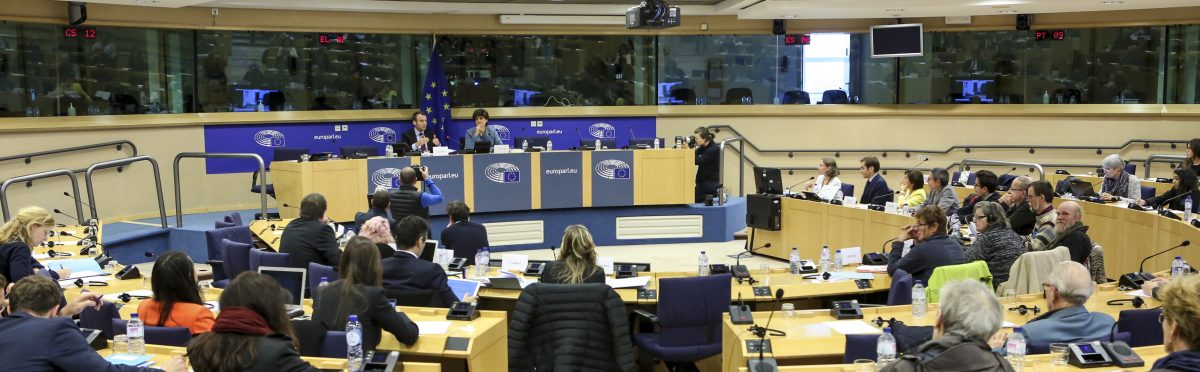
The intergroup opened its meeting to mark the International Day for the Eradication of Poverty with a key note speech from Emmanuel Macron, former French Finance Minister.
In his speech Mr Macron recalled the fact that human rights and the right to a dignified life are at the heart of the European identity, these principles are present in the European Charter of Human Rights.
In today’s society poverty and social exclusion are on the rise: as a result of the crisis, as a result of the transformation of economies and also because of geo-political events. The question that needs to be asked is what can be done to fight against this increased poverty?
The crisis has illustrated our incapacity to provide a coordinated response throughout society and Europe to the problems. Collective decisions have been taken but the outcomes have destroyed certain social balances and contributed to greater social exclusion. The recent influx of migrants and refugees onto European soil has resulted in questions being raised by our societies about our social models. However not everything is only related to the EU and the individual Member States, the transformation of our capitalist systems is a global phenomenon. In this respect globalisation creates imbalances much more quickly than in the past, it creates incredible potential but can also very quickly destroy entire sections of society. It is this societal polarisation of both our societies and our economies which creates more inequality and attacks the jobs of the middle classes and which favours the metropolitan over rural areas. It also creates new types of inequalities. This means that the education, political and social systems of our societies are more deterministic than before, and it enables our society to more easily be broken apart.
New types of inequalities are being created but not necessarily the answers of how to solve them. Western democratic societies are built upon the principles of an adequate political but also social and economic system. In contrast the current global market economy is creating inequalities which are threatening our democratic systems. Brexit and the positive reception to Donald Trump’s proposals are a result of our current incapacity to explain our economic and social systems. Without finding ways to deal with these issues, both politically and economically, then our democracies are at risk of breaking down.
The public policies, such as health and accident insurance and pensions, which were created after the Second World War have needed to be complemented over the last 25 years, for example with the Active Solidarity Income (RSA) in France. Yet often those eligible for this extra aid are not accessing it. Be this because they do not know that they are eligible or because the application process is so complicated it has to be reflected upon how to ensure that those in need are able to access their rights. The simplification of current systems is often necessary. It is also essential to better respond to people’s needs. Old and young people need different help, as often do those living in urban or rural areas, access to housing is not the same thing as reinsertion into the job market. A more sophisticated system of differentiation in our social systems is required.
How can we more effectively fight against poverty and social exclusion? How can we conceive our economic systems differently so that social impacts are taken into account from the beginning, rather than having to be compensated for afterwards? It is only by looking beyond simply the macro-economic situation and putting those who live in poverty at the heart of the discussion about their lives that we can make progress. On the one hand it is important not to place blame on them, for being responsible for their difficult situation, and on the other hand it is essential to consult with them about what could be the possible responses to improve the situation: there needs to be a policy of recognition. Associations working on these issues need to be involved, as do municipalities. All sides need to listen and exchange to create much more pragmatic solutions. It is essential that the most deprived are able to make choices and mobility is key: to be able to have access to housing but also culture and transport, to enable them to have access to the same things as other members of society, for example education and employment and fair chances. As long as our education systems are deterministic then poverty will continue to be created. It is essential to give greater resources to those who have the least, to enable them to have a fair chance, be that those with little education or low income families for example. This can be changed on the political level but it must also change on the economic level. Today every company has a social and environmental responsibility if they want to exist in the long-term. Companies need to have a broader approach than a purely financial one, they need to ensure that everyone in their company has a role. To make this a reality innovative social and environmental policies will be required.
An animated question and responses session allowed certain notions to be clarified and further developed, for example what did Mr Macron mean by a deterministic education system, how to ensure that social exclusion policies are revived to guarantee social recognition, what role needs to be defined for the EU and what role for the Member States, how to manage current trends moving from permanent contracts to flexible ones, how to eradicate the problem of the working poor?
For Mr Macron immediate and long-term solutions are needed to provide social, political and economic responses to the problems of poverty and social exclusion. For all citizens to be represented in the political system then it is essential for all sectors of society to have a political voice and to actively contribute. Minorities need to be recognised and to be able to share their expertise. For Mr Macron there is a great difference between a flexible contract which means you can choose your working hours (and which is often preferred, particularly by young people) and people who have no flexibility and have to accept very demanding schedules and who can end up being working poor. The potential of the trajectory is key: someone can tolerate difficult and sometimes poorly paid conditions for a fixed amount of time, if they know that this experience will provide positive opportunities at a later stage. This is quite different to being trapped in a system where no positive evolutions can be foreseen. Policies are needed which will restore hope to citizens. The EU should react to redefine the common European norms which we want, work to create a balanced, fair society in the future. It is the definition of European norms and goals which will allow its voice to be heard on the international stage.
The first panel focused on the actions of civil society in the fight against poverty with Ivana Di Martino explaining what motivated her to run from Milan to Brussels to fight against child poverty and social exclusion, accompanied by a presentation from Lorenzo Sironi from Barilla, who supported Ivana on her journey. Ivana, a sociologist who is passionate about running decided to use her energy to support the food bank federation. She had been shocked to learn that 23 million children in the EU do not have access to food and felt an obligation to react. In May 2016 Ivana ran from Milan in Italy to Brussels (over 900 km in 13 days) to present her manifesto to representatives of the European Institutions. She was touched during her journey across Europe by all the “hidden heroes” who she met: people and companies that voluntarily give their time to help others.
[Ivana’s journey to Brussels.]
Lorenzo Sironi presented the actions undertaken by Barilla, a company owned by the same family since 1977, working with NGOs and sponsoring actions like Ivana’s and explained why this is important for them as a company. Barilla has a mission for the future to be a virtuous and sustainable company and their motto is “give people food that you would give to your own children”. This ethos feeds into their actions on the one hand for example by donating pasta to food banks or running educational programmes to teach children about eating a balanced diet but also creating and contributing to networks and projects such as Ivana’s in order to fight issues which are important. Ivana’s message spoke to those responsible at Barilla and so they sponsored her journey and helped her to crystallise her message in order to ensure that it reached as many people as possible and helped her to create a logo.
[Click here for Mr Sironi’s presentation]
A discussion followed about the moral implications of private companies being involved in deciding about societal values. For Barilla, there is a demand coming from the public for private companies to make CSR a priority and that these actions actually now affect the markets. The private sector can have a great potential to increase awareness and reach a large public with their actions.
The second panel provided testimonials from Lisa Mckenzie, an ethnographic academic focusing on poverty, and Isabelle Feutry who runs the ATD Fourth World holiday home in France called La Bise, which enables families who cannot afford to go on holiday to have one.
Lisa’s current work focuses on the grieving that inequality brings and the grieving for a life that those excluded might have had had circumstances been different. Her work tries to expose what is hidden in plain sight, often through the medium of photographs which can speak in a way that words cannot. In London there are currently many luxury apartment blocks being developed, which Lisa considers to be a form of social cleansing, as the poor are pushed out from their traditional neighbourhoods and luxury apartments, which are often not lived in full time, take their place. Society chooses not to see the poor who are expelled. Previously in the UK new developments were required to provide a certain percentage of social housing within a new development, but irrespective of this social segregation was ensured by the creation of a different entrance depending on whether you were a private or social tenant, meaning that the two sides never needed to meet. The government and local councils are offering people who are in need of social housing accommodation outside of London, as far away as Liverpool for example, without taking into account that for many of these people their entire support networks are in London and were they to relocate to Liverpool then they would be completely isolated. The alternative to accepting the social housing in Liverpool is often homelessness in the capital.
Lisa reflected on the outcome of the British referendum in June and the majority decision for the UK to leave the EU. For her it is not that the poor and lower class of Britain voted to leave the EU, rather that they voted to be seen and heard.
[Click here for the presentation of Lisa McKensie]
Isabelle Feutry presented the work of La Bise holiday home, a pilot project of ATD Fourth World to provide a place where families who normally would not have the means to go on holiday can come together for a family holiday in the Jura in France. La Bise can accommodate 5 families and 10 volunteers. ATD have created a “laboratory of communal living” where everyone present will learn together. La Bise is not a social laboratory, in the sense that there is no written report at the end which would be submitted to social workers or the children’s schools for example, which is a great relief to the parents who are used to being scrutinised in their every move. The point of these holidays is to provide an environment where the families are accompanied but free and not judged.
La Bise normally welcomes families where the children are in care. These holidays require a great deal of preparation: between the families, their social workers and the team at La Bise. Families make a financial contribution to their stay (in France holiday cheques exist for example for low income families) and the point of the stay is to place the family at the heart of the holiday and to ensure that children and adults are proud of what they have done. Many elements of the holiday are communal, the five families and ten volunteers live together in the house, they prepare the meals and eat together and do joint activities. However family time is also essential, afternoons when the families do activities, be it cycling in the woods, going fishing, arts and crafts, just as a family allows them to create common experiences. During their time at La Bise each family makes a photo album with souvenirs from their trip – important for their memories and to show neighbours, friends, class mates and social services what they did on holiday.
La Bise is part of a network in favour of holidays as a tool to fight against exclusion which was created after the 1998 law of orientation against exclusion which stated the right to be able to have a holiday. This political action aims to illustrate that by ensuring that everyone has the right to a holiday, which can help them to be able to support themselves, to decide how they want to live their lives, that it is possible to contribute to the fight against social exclusion and poverty.
[Click here for a presentation of La Bise]
Francine van Beneden, a member of ATD Fourth World who has in the past been homeless, explained how important her experience of participating in a holiday villa in Spain with her children during that time had been for her whole family and how much they had learnt about living together and the importance of culture in their lives during their trip.
The discussion at the end of the panel focused on the question of semantics, is ‘holiday’ the right word to be using, do people who do not work have the right to ‘take a break’? Lisa concluded with her belief that it is exactly the right word, as she is in favour of society rising up together with equality for all, rather than only a few deprived people being able to escape poverty and climb the social ladder.
The final speech of the afternoon was made by Marianne Thyssen, European Commissioner for Employment, Social Affairs, Skills and Labour Mobility who came to discuss the proposal for a European Social Pillar. It has been proven that inequalities hamper growth and has negative impacts on the whole of society. This is why the Commission has set out to achieve an EU with a AAA social rating. The economic and social crisis has resulted in the EU 2020 strategy to reduce the number of Europeans at risk of poverty being the one which is most off course, but that is no reason to give up. The EU needs fair and balanced growth, with decent and high quality jobs and social protection.
The aim of the social pillar is to examine the existing legislation, tools and principles on employment, labour market, labour rights and social protection policy and to see where revisions are needed. Social policy needs to be fit for purpose and to provide equal opportunities, access to education, quality public services, the right working conditions and adequate social protection systems. Modern social protection systems must protect all, they must support the development of competences and skills as these are key for growth and opportunities. Adequate access to benefits, quality enabling services coupled with activation measures is required. Within the social pillar proposal there is a strong focus on fighting poverty and social exclusion, with a framework proposal principle to ensure access to adequate social protection such as minimum income, social housing, childcare, healthcare and long-term care.
It is important to recognise however that the EU does not have competencies in all these areas so the Commission will use the tools at its disposal as appropriate – through legislation, the European Semester, exchanges of best practices, establishing benchmarks in order to make progress.
In the question and answer session the issue of extreme poverty, notably the issue of homelessness, was raised and questions about how the Commission was going to deal with that as it is not covered in the social pillar.